Vibe Coding vs No-Code: Which Is Better for Building Business Apps?
Vibe coding has quickly become one of the most talked-about ways to build software.
Instead of working with traditional code or configuring visual workflows, you simply describe what you want in natural language. An AI model generates the application, you test it, ask for changes, and continue iterating until the result feels right.
For someone who has never been a developer, that can feel revolutionary.
At the same time, no-code platforms have spent years solving a similar problem from a different direction: making software development accessible without requiring users to understand programming languages, frameworks, deployment pipelines, or application architecture.
So a natural question has emerged:
Is vibe coding actually better than no-code?
The answer is not as simple as choosing one winner.
Vibe coding and no-code are excellent at different things. The right choice depends largely on whether you are experimenting with an idea or building a system that your business will eventually depend on.
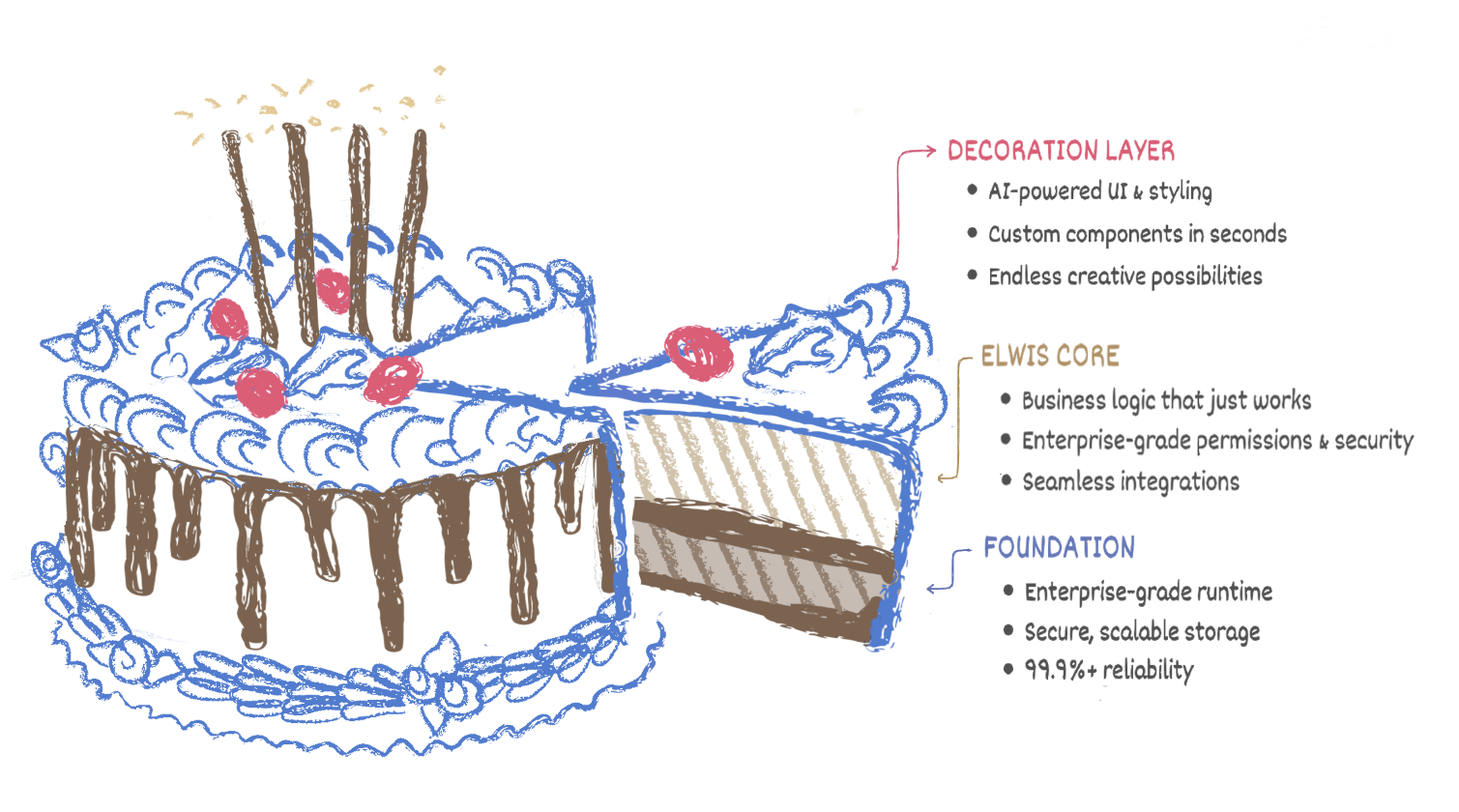
No code is deterministic
AI is decoration
What Is Vibe Coding?
Vibe coding is an AI-assisted development approach in which users describe an application or feature using natural language and allow an AI coding assistant to generate much of the underlying code.
Instead of writing functions manually, you might ask:
"Create a customer portal where users can log in, submit requests, see their order status, and receive notifications."
The AI generates the application structure and code. You then continue refining the result through prompts.
The attraction is obvious.
A person without years of programming experience can go from an idea to something functional surprisingly quickly. That makes vibe coding particularly attractive for prototypes, experiments, personal tools, landing pages, and early-stage product ideas.
The rapid growth of AI-assisted development tools shows that this approach is more than a temporary trend. Vibe coding platforms are increasingly being used by individuals and companies to quickly create applications through natural-language instructions.
But generating an application is only one part of software development.
Maintaining it is another.
What Is No-Code?
No-code takes a different approach.
Rather than asking AI to continuously generate source code, users build applications using visual components, structured data models, workflows, permissions, forms, dashboards, and predefined application logic.
In ELWIS, for example, applications can be created visually without requiring traditional programming knowledge. Users work with components and structured logic while the platform handles much of the technical complexity underneath.
The important difference is visibility.
With no-code, the person building the application can normally see how the system is structured:
- what data exists,
- how objects are connected,
- what happens when an action is triggered,
- which users have access,
- and how a workflow moves from one stage to another.
You may not see thousands of lines of source code, but you can understand the application's logic.
That distinction becomes increasingly important as an application grows.
IMAGE:
Vibe Coding vs No-Code: The Main Difference
Imagine you want to automate an order management process.
With vibe coding, you could describe what you need:
"Build an order management system with customers, orders, approval workflows, email notifications, and a management dashboard."
The AI may generate a working application remarkably quickly.
With a no-code platform such as ELWIS, you would model the same solution visually: define customers and orders, establish relationships, configure statuses and permissions, create pages, and build the workflow using reusable components.
Both approaches can lead to a functional application.
The difference is what happens after the first version works.
Vibe coding optimizes heavily for generation.
No-code platforms optimize for structured creation and ongoing management.
That distinction is particularly relevant for business applications.
Where Vibe Coding Is Strong
Vibe coding has several undeniable advantages.
Extremely Fast Prototyping
If you have an idea and want to see whether it works, AI-generated development can be incredibly fast.
You can create interfaces, test workflows, and explore ideas without spending days setting up a development environment.
For startups and entrepreneurs, that makes vibe coding a powerful experimentation tool.
More Freedom at the Code Level
Traditional no-code platforms provide predefined components and patterns. Vibe coding can potentially generate almost anything that can be expressed in code.
If you need an unusual interface, experimental feature, or highly specific technical behaviour, AI-generated code may offer greater freedom.
Learning Through Building
For people interested in programming, vibe coding can also become an educational tool.
Instead of starting from a blank editor, beginners can ask AI to create something and then examine how the generated application works.
Several developers and non-developers experimenting with vibe coding describe exactly this effect: AI lowers the barrier to starting, while users gradually learn more about software development as projects become more complex.
Where the Difficulty Starts
The challenge appears when a prototype becomes important.
A personal tool behaving unexpectedly is inconvenient.
A CRM used by 50 employees behaving unexpectedly is a business problem.
Once an application handles customers, invoices, projects, orders, employee permissions, or sensitive business data, different questions become important:
Who understands the architecture?
Who can troubleshoot the application?
What happens when a generated dependency changes?
How are permissions managed?
How do you know that a new AI-generated modification has not broken something elsewhere?
How is the application deployed?
Who maintains it two years from now?
This is one of the recurring concerns in discussions around vibe coding. The ability to generate code does not automatically provide understanding of the generated system.
That does not mean vibe-coded software is inherently unreliable. Experienced developers can use AI coding tools very effectively because they can review architecture, test output, identify vulnerabilities, and correct mistakes.
The risk increases when nobody involved understands what has been generated.
Why Visual Logic Still Matters
One interesting point raised in the debate around vibe coding is surprisingly simple:
If you are not a developer, would you rather maintain thousands of lines of AI-generated code or a visual representation of how your application works?
That question explains why no-code remains relevant even as AI becomes better at generating software.
Visual development gives business users something extremely valuable: a mental model of the application.
A workflow can show that:
New order → validation → manager approval → customer notification → processing → completion.
The builder can see the process.
The team can discuss it.
Someone else can modify it later.
The application is not just generated. It is structured.
ELWIS follows this philosophy by allowing users to create interfaces, data structures, and application logic visually while maintaining control over how the solution behaves.
Vibe Coding vs ELWIS
For business applications, the comparison looks something like this:
Area
1.) Getting from idea to prototype
2.) Programming knowledge required
3.) Understanding application logic
4.) Custom UI freedom
5.) Business workflows
6.) Data model
7.) User roles and permissions
8.) Maintenance
9.) Deployment
10.) Best fit
Vibe Coding
1.) Extremely fast
2.) Not necessarily at first
3.) Can become difficult without technical knowledge
4.) Very high
5.) Must be generated and maintained
6.) AI/code-defined
7.) Must be implemented correctly
8.) Requires understanding generated code or AI assistance
9.) Depends on generated stack and hosting
10.) Experiments, prototypes, custom code
ELWIS No-Code
1.) Fast
2.) No
3.) Visual and structured
4.) Based on configurable platform components
5.) Built visually
6.) Structured and configurable
7.) Platform-managed
8.) Managed through the platform
9.) Platform-managed deployment
10.) Operational business applications
Neither approach wins every category. The real difference is what you are trying to build.
Prototype or Business System?
Consider two scenarios.
Scenario 1: Testing a New Idea
You want to know whether customers would use a new scheduling application.
There are no employees depending on it.
There is no sensitive operational data.
You may throw the prototype away next month.
Vibe coding can be an excellent choice.
Generate something quickly, test the concept, gather feedback, and decide whether the idea deserves further investment.
Scenario 2: Building an Internal CRM
Now imagine your sales and operations teams will use the application every day.
It contains customer records, activities, projects, invoices, expenses, tasks, permissions, dashboards, and business workflows.
The application may remain in use for years and continuously evolve.
At that point, maintainability, permissions, structure, deployment, scalability, and governance start to matter as much as development speed.
That is where a no-code platform such as ELWIS becomes particularly valuable.
ELWIS is designed for building operational applications including internal tools, portals, workflow systems, and custom business applications without requiring organisations to create and maintain an entirely new software stack for every solution.
No-Code Is Also Becoming More AI-Driven
There is another reason the debate may eventually become less relevant.
No-code and vibe coding are beginning to converge.
AI is increasingly becoming part of visual application development. Instead of choosing between prompting and visual configuration, future platforms are likely to combine both.
A user might describe:
"Create an order approval process with two approval levels and notify the customer when the order is approved."
AI could create the initial workflow.
But rather than leaving behind an unfamiliar codebase, the result could appear as editable objects, workflows, attributes, and pages inside a structured no-code environment.
That gives users the speed of natural-language creation while preserving the visibility and maintainability of visual development.
ELWIS has already identified AI-assisted creation and visual scripting as important directions for the evolution of no-code platforms.
This is arguably where application development is heading.
Not AI versus no-code.
But AI inside no-code.
The Hidden Question: Who Maintains the App?
When comparing development methods, most discussions focus on how quickly the first application can be created.
Businesses should ask a different question:
Who will understand and maintain this application after the person who created it is gone?
For a weekend experiment, that may not matter.
For an application managing customer orders, financial approvals, healthcare processes, or internal operations, it matters enormously.
Software has a lifecycle.
It changes.
Employees request new functionality.
Processes evolve.
Regulations change.
Integrations need updating.
Managers want different reports.
The cost of an application is therefore not only the cost of building version one. It is the cost of changing versions two through twenty.
A structured no-code platform gives organisations a consistent environment in which those changes can be made without repeatedly rebuilding the application's technical foundation.
So, Is Vibe Coding Better Than No-Code?
Sometimes.
If your goal is to turn an idea into a prototype tonight, vibe coding may be the fastest and most flexible option.
If your goal is to experiment with software, learn, or build something highly custom, it can be remarkably powerful.
But if you are building a system that will manage real business processes, multiple users, permissions, customer information, approvals, reporting, and integrations for years, the question changes.
You are no longer asking:
"How quickly can I generate an app?"
You are asking:
"How easily can my organisation operate, understand, modify, and scale this application?"
That is where no-code platforms such as ELWIS have a different advantage.
They do not simply remove coding.
They provide a structured application environment in which business software can be built and continuously adapted without forcing every organisation to become a software engineering company.
The Best of Both Worlds
Vibe coding has changed expectations around how quickly software can be created.
That is a good thing.
No-code changed expectations around who could create software.
AI is now pushing that idea even further.
The most interesting future is therefore probably not a battle between the two approaches.
It is their intersection:
describe what you want with AI, understand it visually, and operate it on a structured platform.
For businesses, that combination could offer something much more valuable than simply generating code faster: the ability to continuously turn changing processes into working software without losing control of the system behind them.
Elwis
Our Approach - no-code and on top we will have areas for vibecode - deterministic. The top layer can be done by vibecode - the core we have knowledge.
MCP server - prompt via mcp and is working with the blocks that elwis has defined that are tested and proven.
If you have prompt app as black box - in elwis we know the core what is inside we only add values on the
.png)