Paper service cards, scattered spreadsheets and phone calls to parish offices — that was instrument and maintenance tracking at one family-run organ-building workshop, at a time when a growing base of historic instruments needed careful, provable upkeep. ELWIS replaced it with one secure, no-code record of every instrument's life.
The problem
The workshop's process was fragmented and labour-intensive: service records spread across paper cards, spreadsheets and disconnected systems, parish offices contacted manually, maintenance contracts and insurance valuations hard to track, duplicates common whenever an instrument changed custodianship. Reporting instrument condition to church boards, appointed organ experts and heritage authorities was slow — and decades of restoration photos and reports difficult to keep consistent. Compliance adds pressure: the platform must align with monument-protection records and data-privacy requirements.
01
Which instruments are due for tuning or service?
02
Which maintenance contracts are expiring?
03
How long does a condition report really take?
04
Is everything ready for the next service visit?

Centralized records
Centralize every instrument's build and service history.

Digital contracts
Track digital maintenance contracts per instrument.

Automated reminders
Automate tuning and service reminders.

Visit management
Manage on-site service and restoration visits.

Condition reports
Generate condition and compliance reports.

Data protection
Protect sensitive customer and location data.

Easy to adapt
Adapt easily as services and instrument types evolve.
Key features
The capabilities that replaced paper files, phone calls and manual service tracking.
INSTRUMENTS
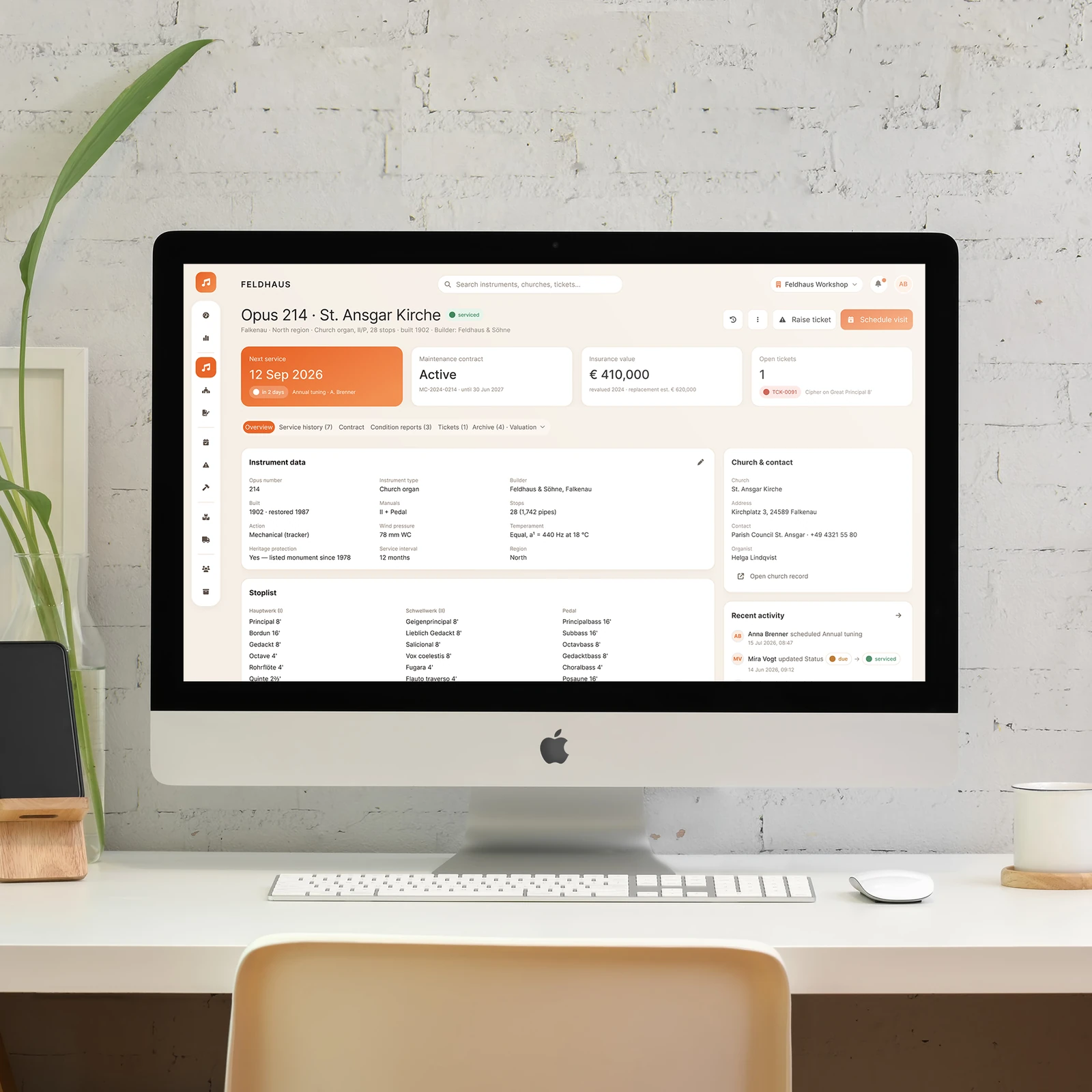
A searchable instrument list across churches and customers — filter by type (including portable chest organs), region or service status, with a maintenance indicator for every organ. Each profile shows build year, stoplist, service history, restoration notes and current insurance value, and flags overdue maintenance automatically.
PROJECTS
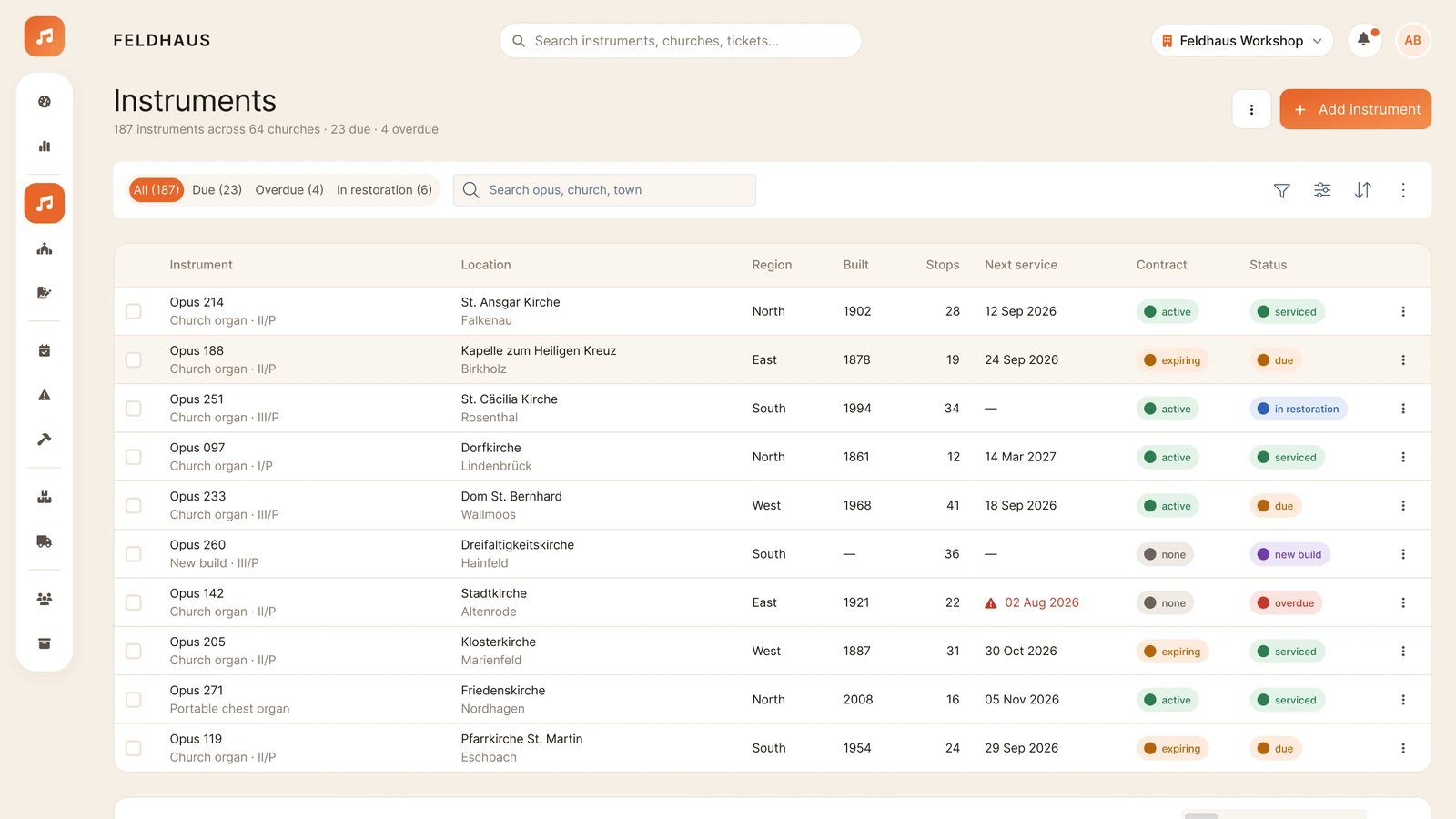
Long-running new-build and restoration projects move through clear phases — quotation, planning, construction or restoration, voicing and formal handover — each with its own checklist and photos. The appointed organ consultant who signs off the finished work for the diocese or parish is attached directly to the project.
CONTRACTS
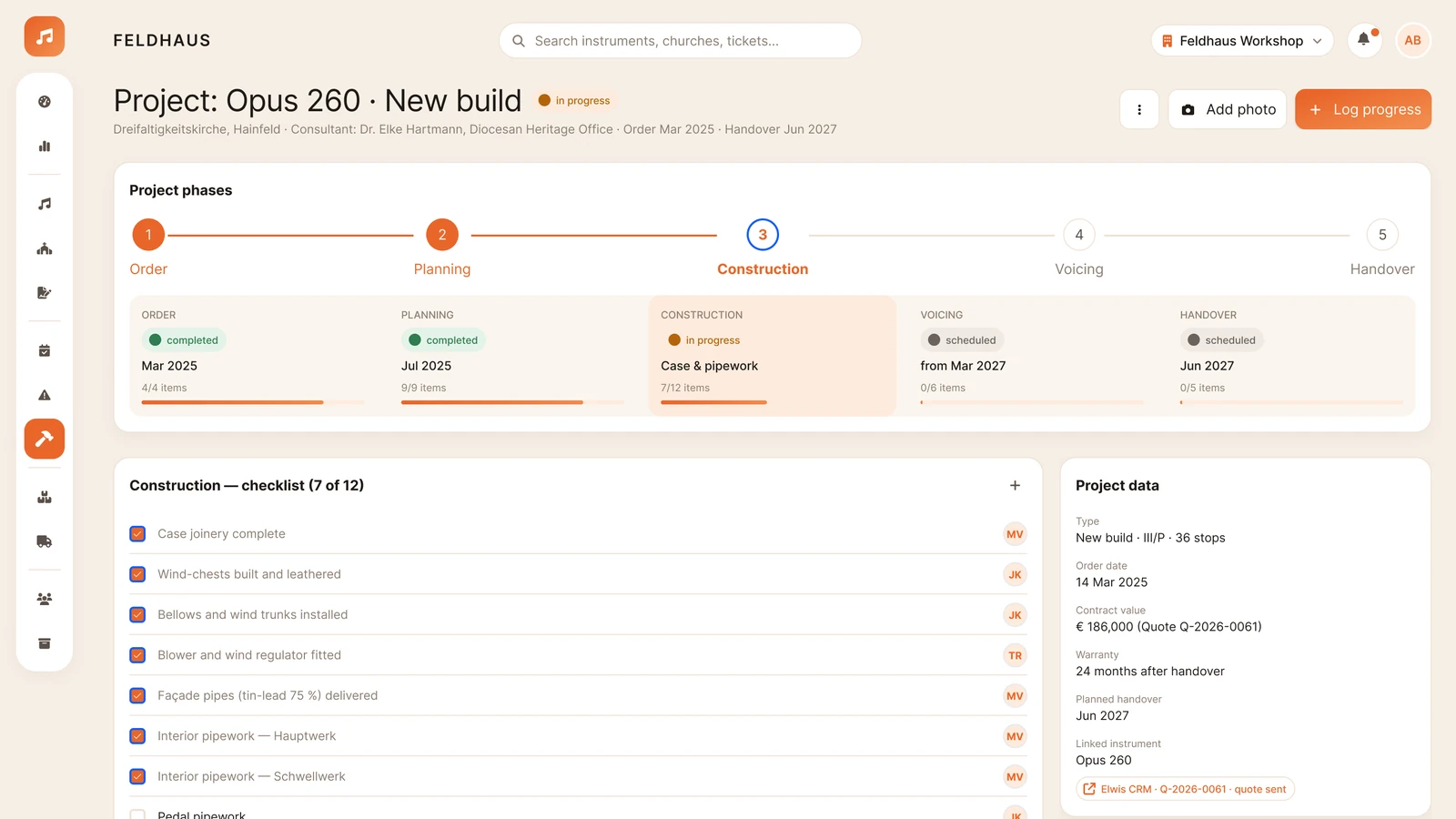
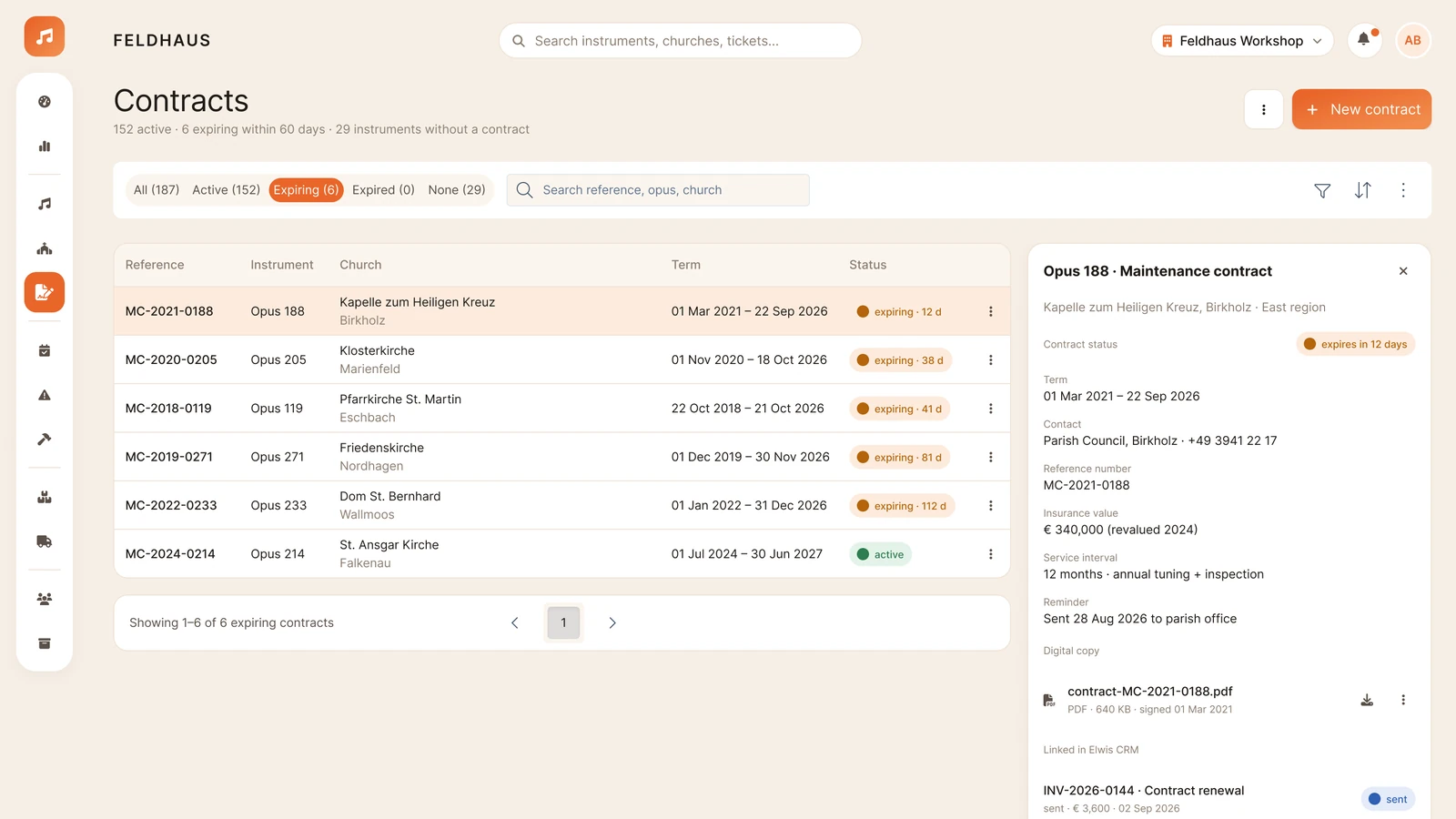
Contract status for every instrument — active, expiring or none — with a digital copy or reference number attached. Missing contracts are flagged right on the instrument profile.
VALUATION
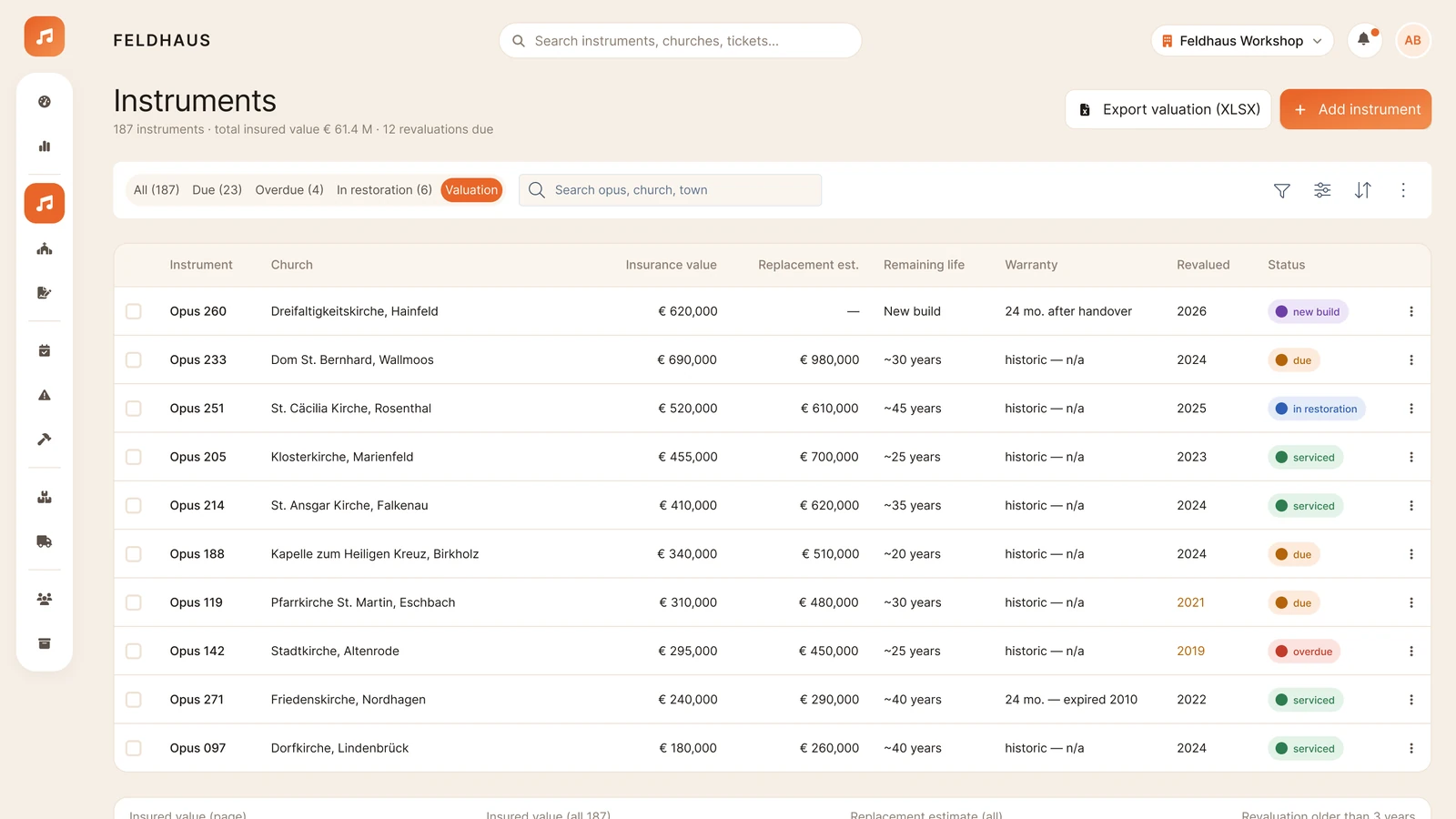
Insurance value, estimated replacement cost and remaining useful life sit next to each instrument's service history, giving church boards and finance teams the numbers for long-term budget planning. New builds carry a warranty period that counts down automatically after handover, while century-old instruments simply show “historic — n/a”. Valuation and warranty are just attributes on the existing Instrument type — no separate spreadsheet, and no developer needed to add a field.
VISITS
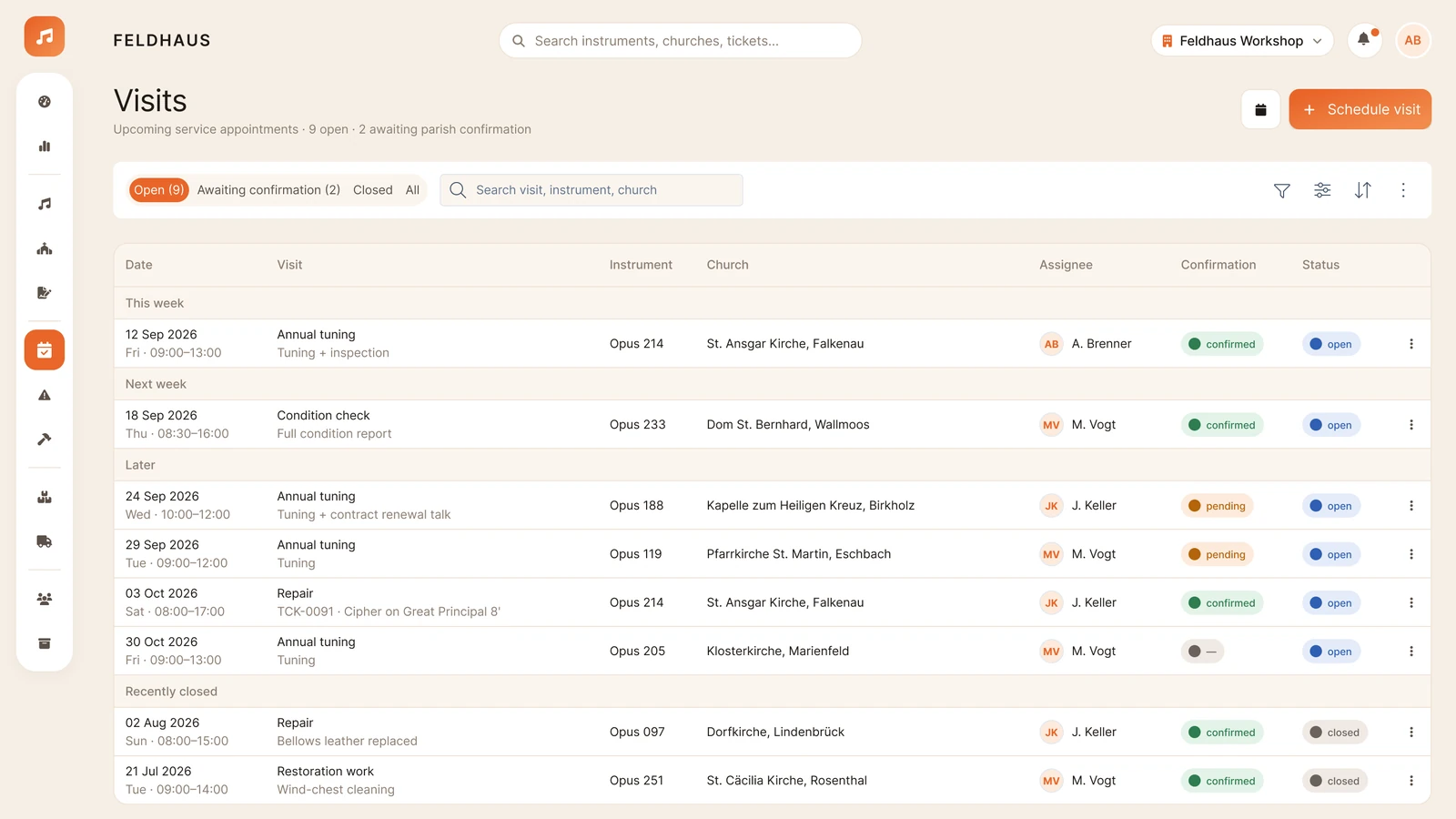
Scheduled visits hold the church, date, assigned craftsperson and planned work, auto-generate checklists of due maintenance — and record findings and outcomes after the visit.
ISSUE REPORTING
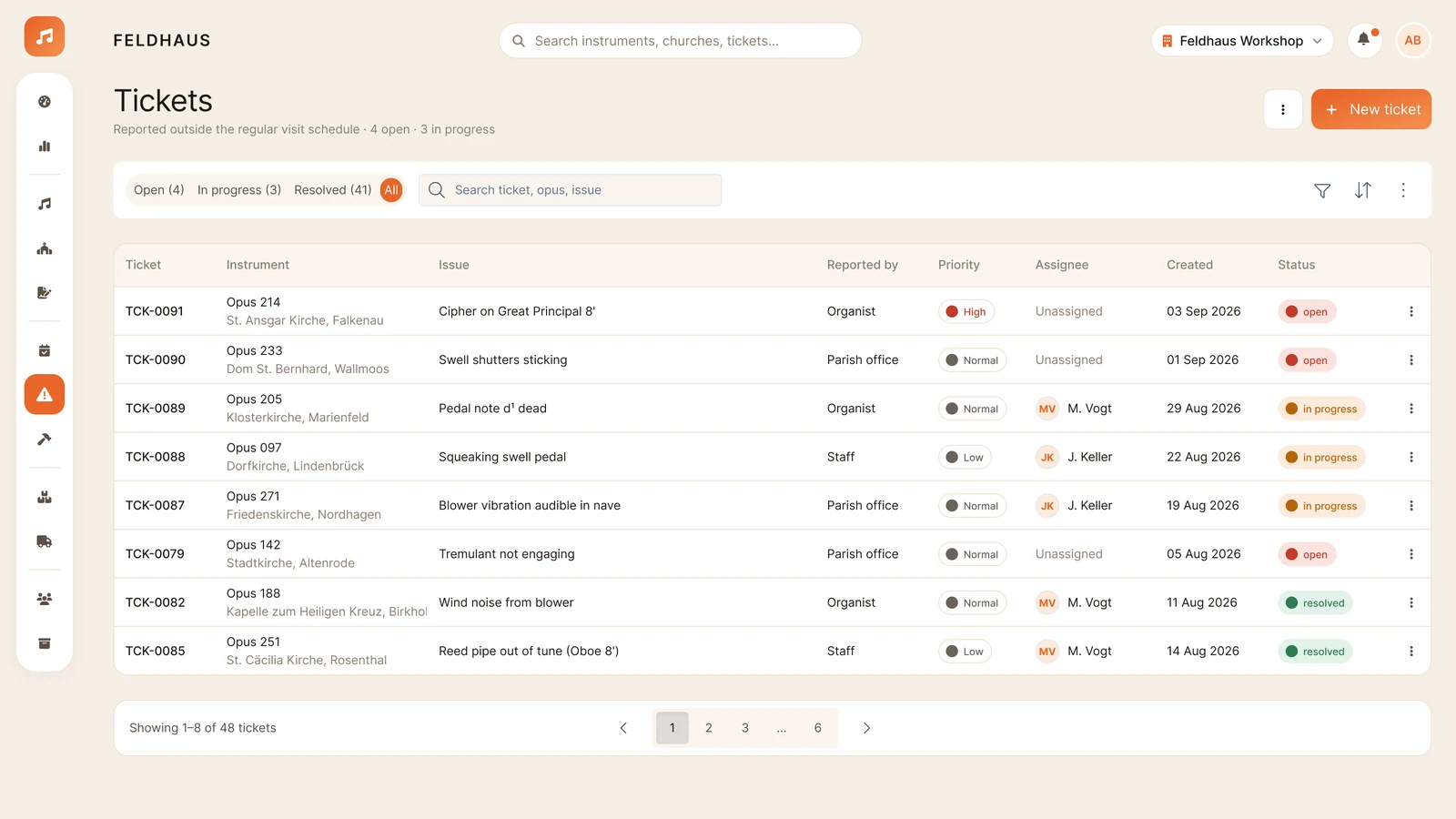
Not every fault waits for the next scheduled visit. A parish office or organist can raise a ticket straight from the instrument's record — a cipher, a stuck key, a noisy blower — which is triaged, assigned to a craftsperson and tracked through to resolution, separate from the regular visit calendar. Tickets are simply another artifact type linked to the instrument, not a bolted-on helpdesk system.
PARTS
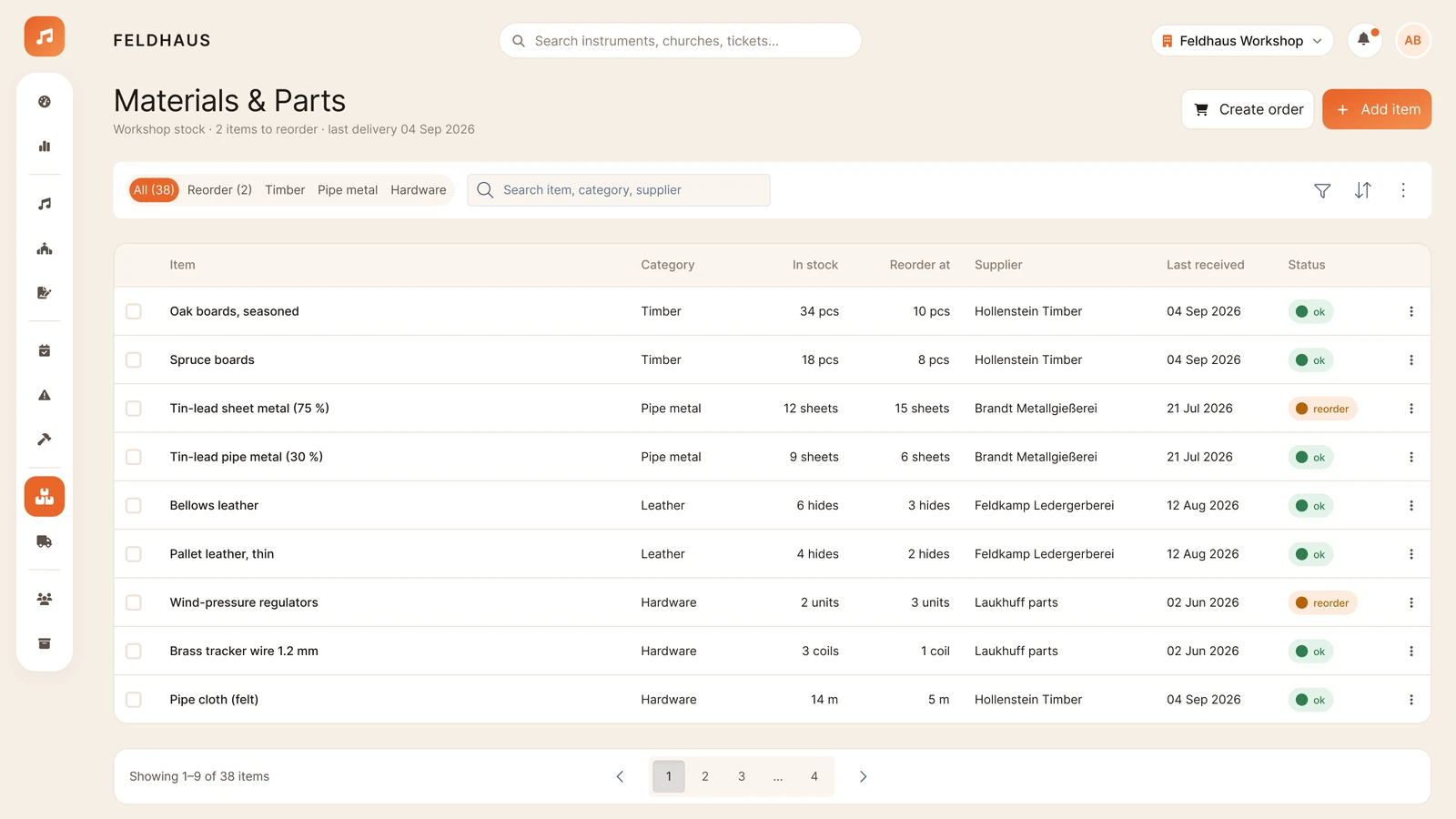
Oak and spruce boards, tin-lead pipe metal, bellows leather and hardware live as their own artifact type, linked to the instruments and visits that use them. Low-stock items are flagged automatically — the inventory type was added later, directly in the Page Builder, without a line of code.
SUPPLIERS
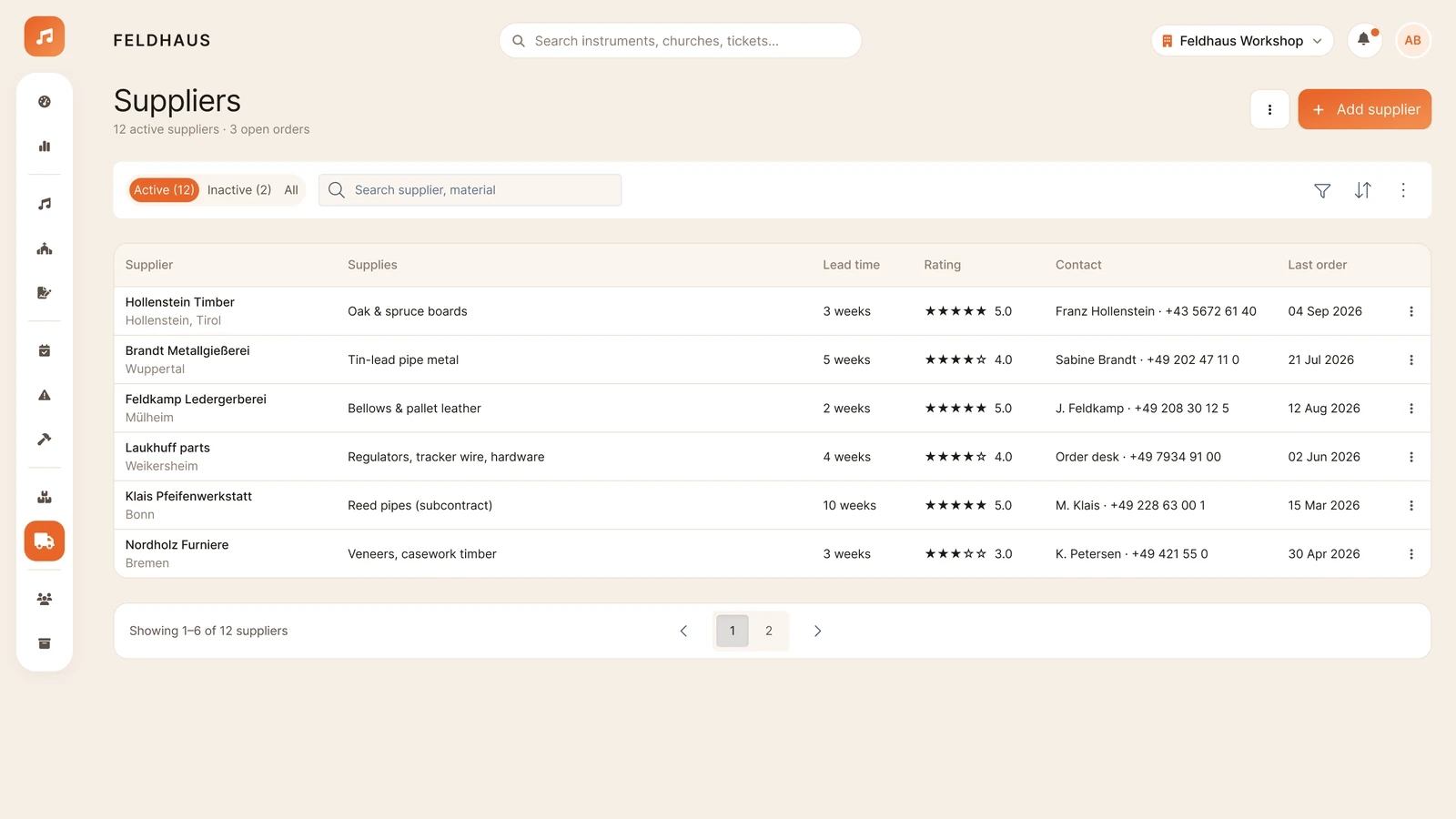
Timber merchants, pipe-metal foundries and leather tanners are tracked as their own artifact type, linked to the materials they supply — lead times, prices and quality notes included, so reordering never starts with a phone call to find the right contact.
INSPECTIONS
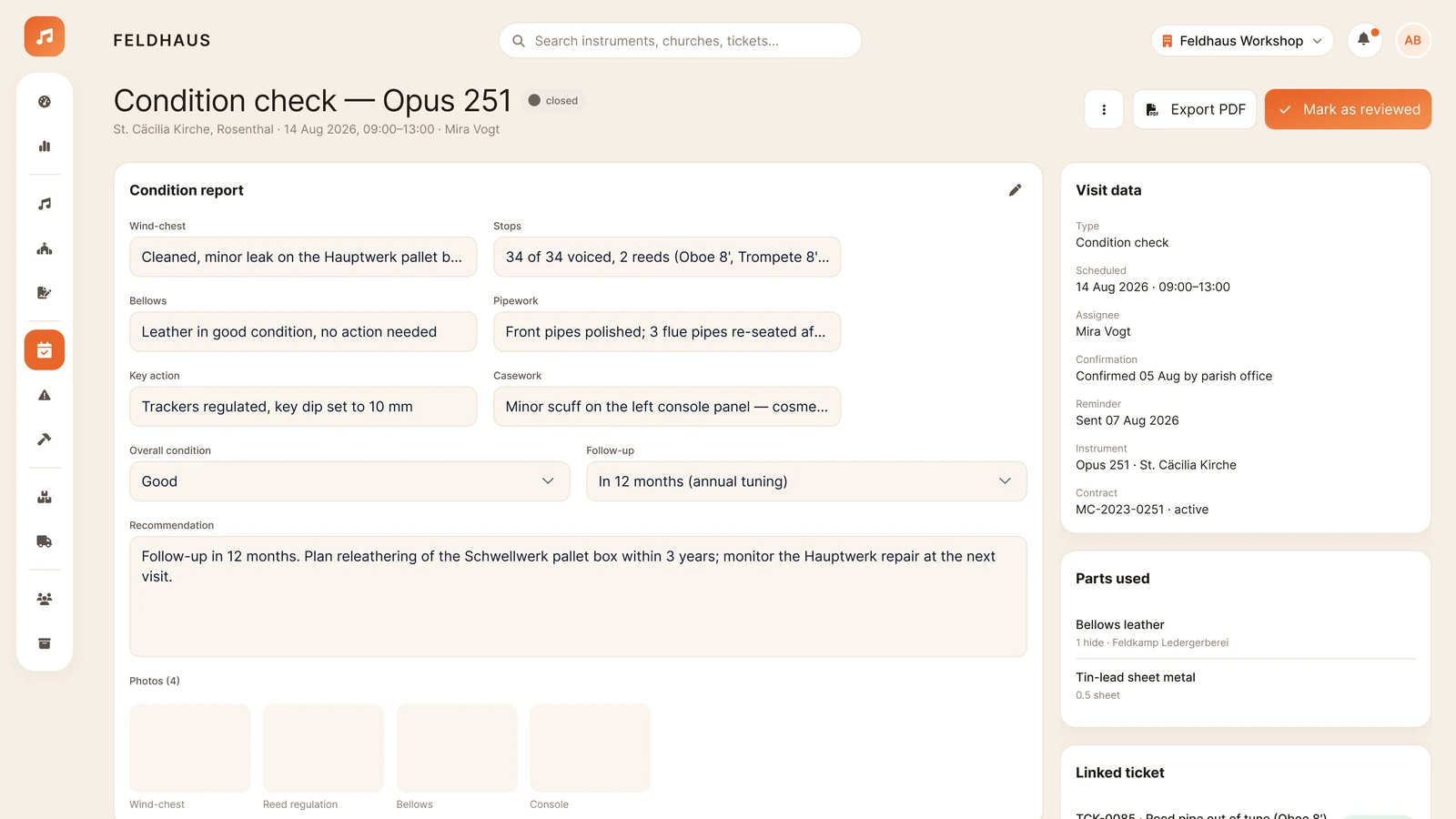
Every visit in one place: the instrument, notes and the full condition report. Pre-built fields speed up data entry and cut human error — and every change is tracked.
ARCHIVE
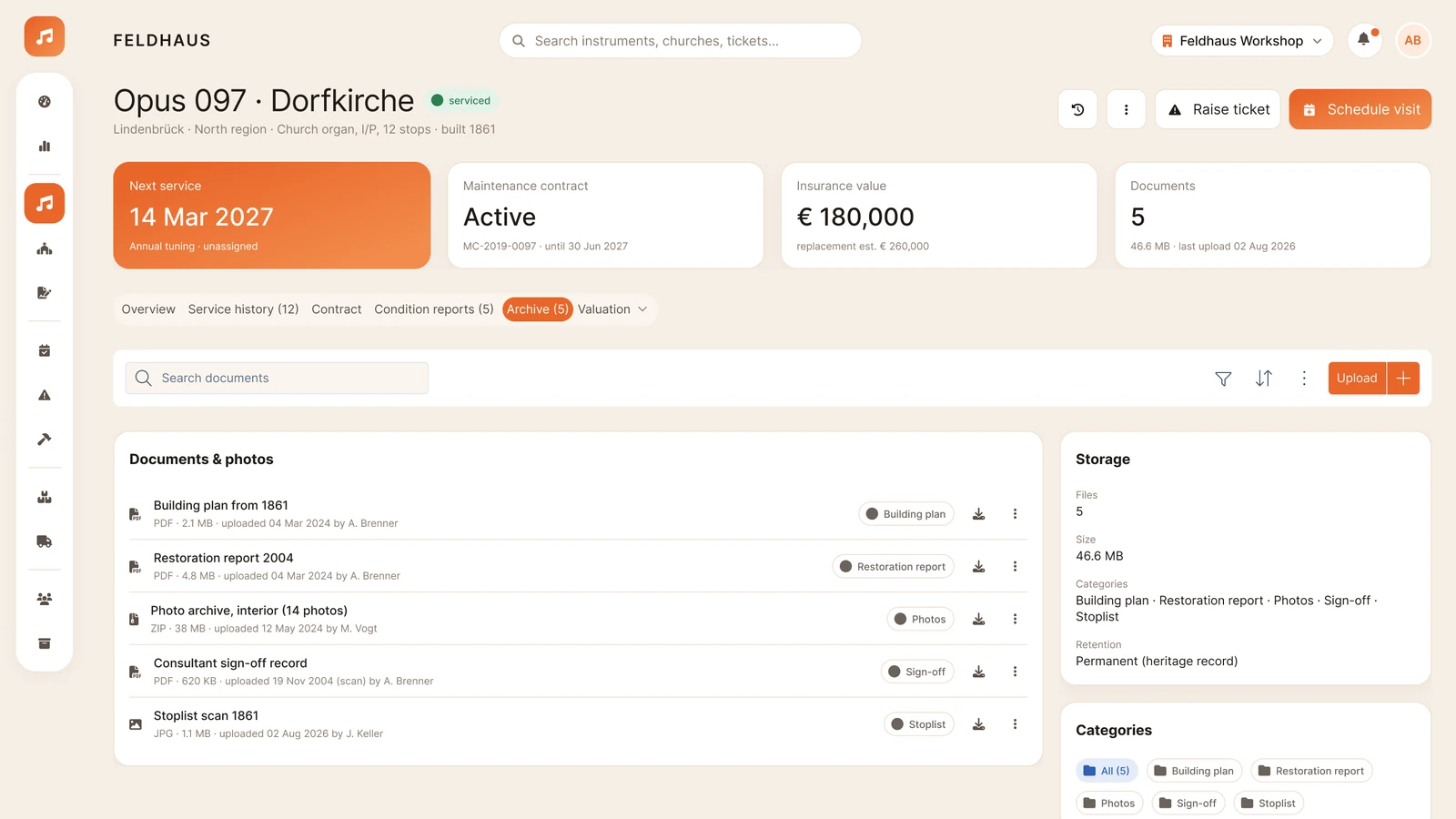
Historic building drawings, past restoration reports and condition photos live directly on the instrument profile — the same kind of archive many workshops keep for their restored organs, now searchable instead of stored in binders.
ANALYTICS
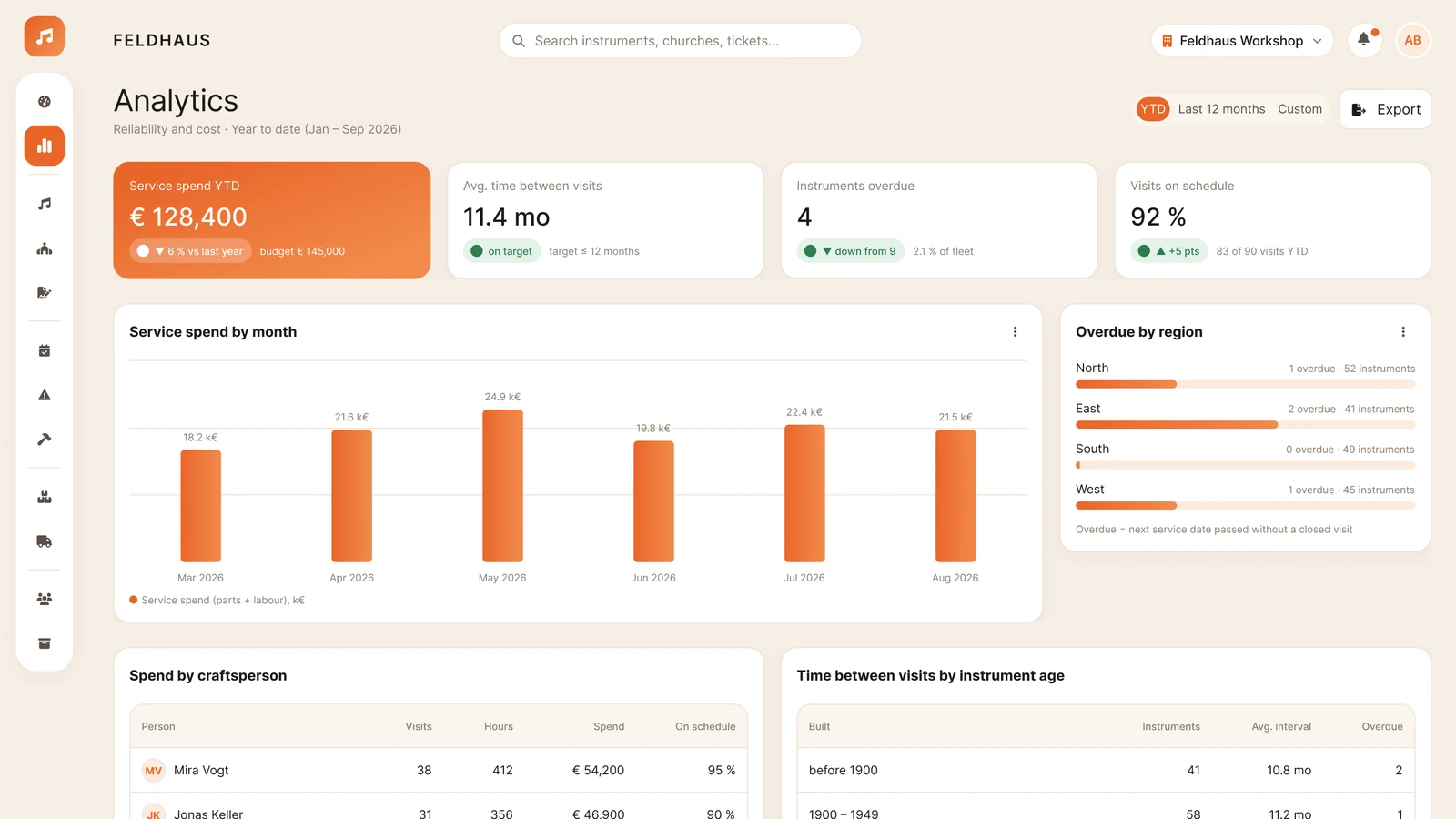
Dashboards break down maintenance spend, average time between visits and overdue rates by instrument, region or craftsperson — the same metrics a factory would track for machinery, adapted to pipe organs. Because the metrics are just another view over existing artifact data, a new chart is a Page Builder change, not a software release.
REPORTING
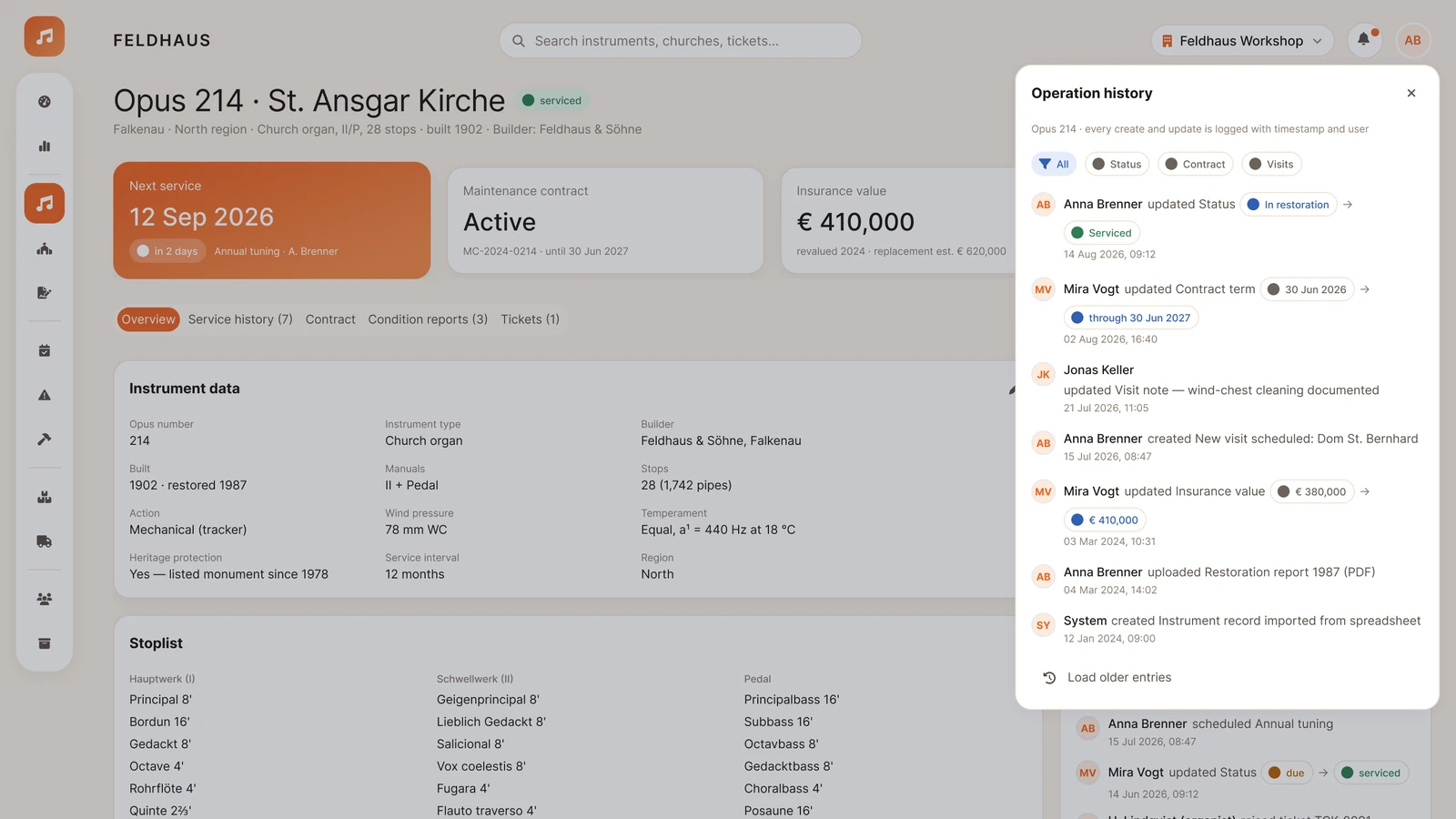
Detailed exports for church boards and heritage authorities on instrument condition and service history. Every create and update is logged with timestamp and user ID.
COMMUNICATION
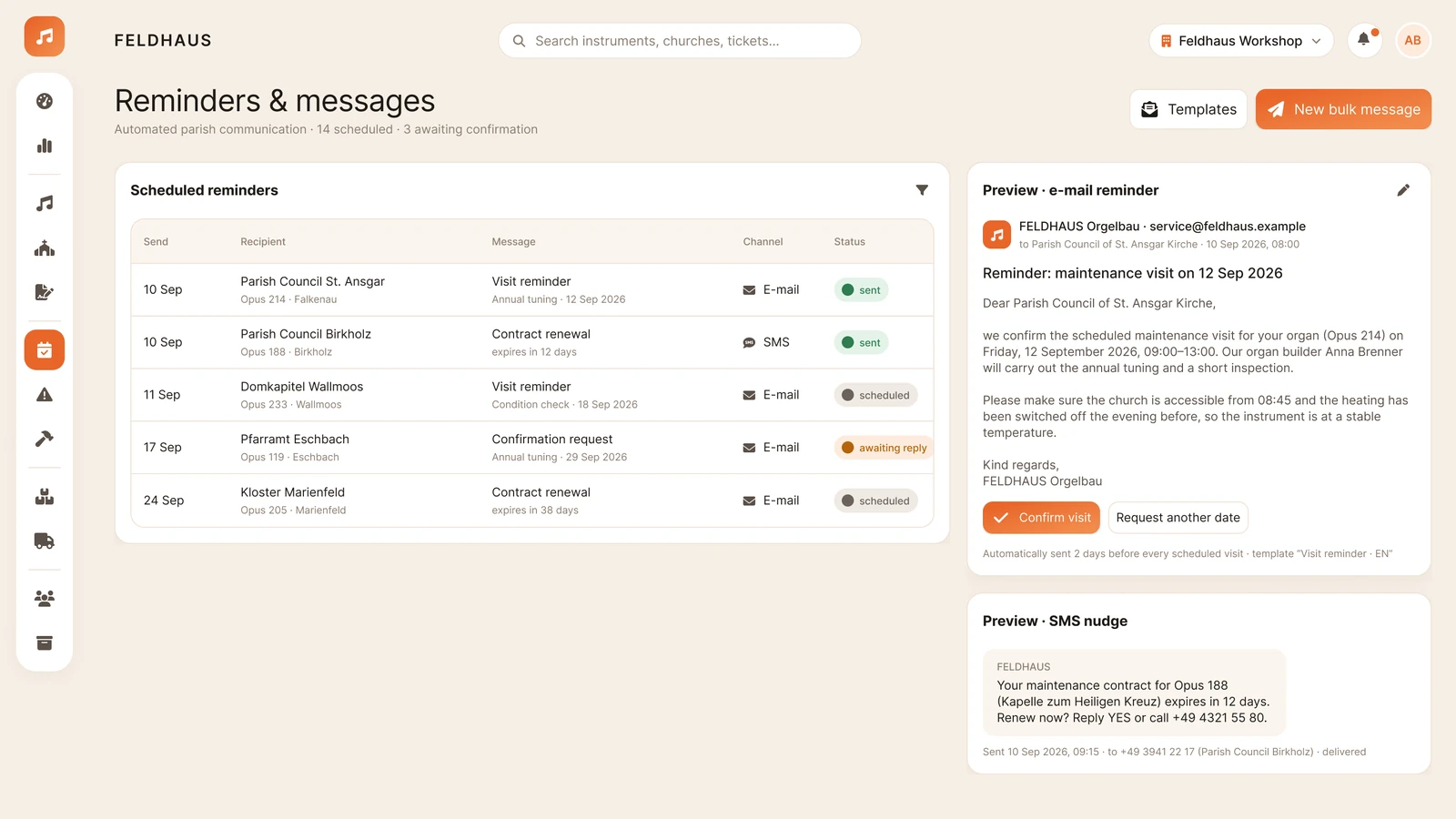
Branded reminders about upcoming tuning, service visits and contract renewals — plus targeted bulk messages to parish administrators before every visit.
MOBILE
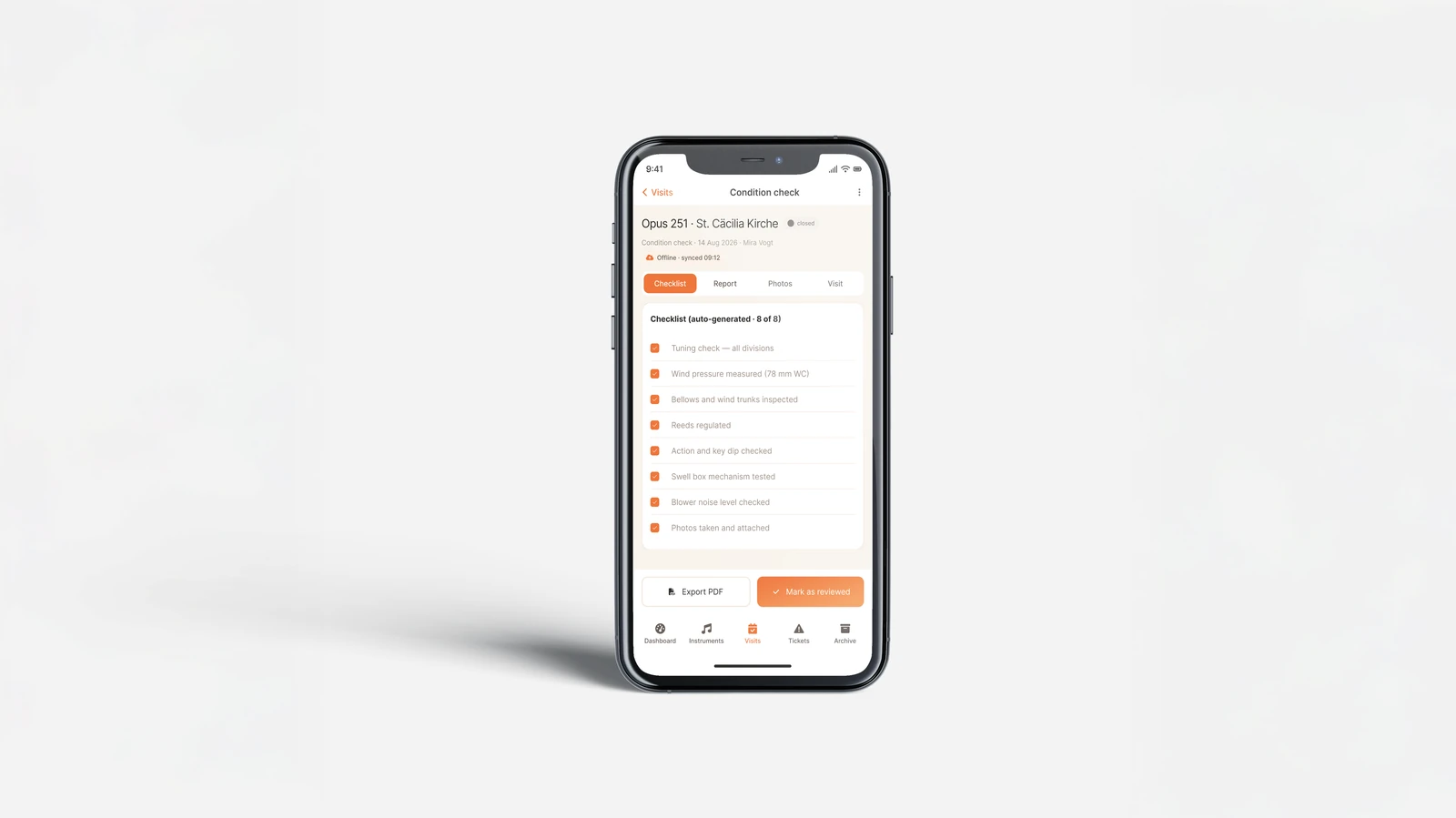
On service day the craftsperson records each task with a tap on a tablet. Forms come pre-filled — and the system works offline when an old church's signal doesn't reach.
FINANCE & INVOICING
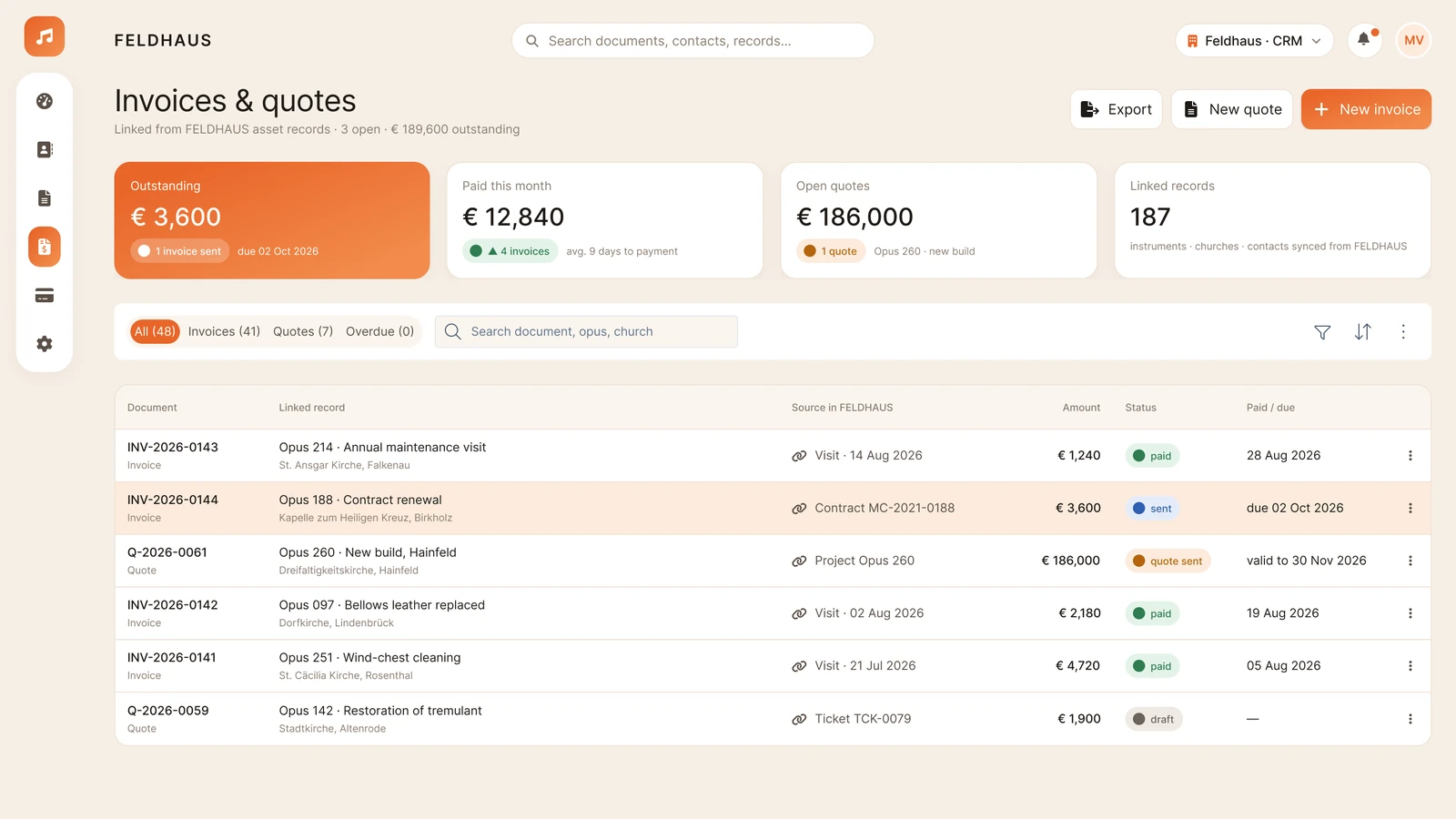
Asset management isn't finance software, so this system doesn't try to become one. Instead, a signed maintenance contract or a completed service visit can be handed to Elwis CRM — Elwis's own quoting, invoicing and payments application — with the instrument, church and contact already attached. One low-code platform, two connected applications, no exported spreadsheets and no third-party accounting tool to reconcile.
The solution
Every build starts the same way: map how the workshop actually works, then model it in ELWIS — custom development blended with a powerful no-code layer.
Page Builder
Compose screens and workflows visually — with role-based views for craftspeople, office staff and management.
Configurable Type System
Artifact types, link types and attributes model instruments, service visits, contracts and staff roles.
Client-owned governance
The client creates and edits artifacts, artifact types and attributes directly — without relying on developers.
Before / After
A manual, paper-heavy process turned into a streamlined digital workflow.
Area
Before
After ELWIS
Instrument & Service Records
Service records were scattered across paper cards, spreadsheets, and disconnected systems.
All instrument records are securely managed in one centralized platform.
Contracts & Customer Communication
Maintenance contracts and parish reminders were tracked manually through emails, letters, and phone calls.
Digital contract management and automated reminders streamline communication.
Maintenance Compliance
Staff had limited visibility into overdue maintenance and instrument-wide condition.
Real-time dashboards provide instant visibility into contracts, pending visits, and overdue maintenance.
Reporting & Visit Management
Visit preparation and condition reporting required manual data collection and administrative effort.
Service visits, reporting, and audit trails are managed automatically from a single application.
Issue Reporting
Unplanned faults reached the workshop by phone or a note passed along at the next visit — easy to lose, hard to prioritise.
Parishes raise a ticket straight from the instrument's record; it's triaged, assigned and tracked to resolution like any other artifact.
Projects & Valuation
New-build and restoration projects lived in offer letters, phase notes and paper archives; insurance values were rarely kept current.
Every project moves through tracked phases with photos and expert sign-off, and insurance values stay current on the instrument profile.
Parts, Suppliers & Spend
Material stock, supplier contacts and maintenance spend lived in separate notebooks, with no shared view.
Inventory, suppliers and year-to-date spend sit on the same platform as the instruments they relate to — added as new artifact types, not a new system.
Quotes & Invoicing
Quotes and invoices were written up separately in accounting software, disconnected from the instrument and contract they belonged to.
Contracts and visits hand off directly to Elwis CRM, Elwis's own invoicing application — same platform, same records, nothing re-typed.
How it works
The application guides staff through every stage of the service process.
1
Schedule a visit
Identify instruments due for tuning or service.
2
Send reminders
Automated reminders to parish offices.
3
Review confirmations
Pending confirmations checked before the visit.
4
Record on tablets
Service work logged during the visit.
5
Update records
Instrument records update automatically.
6
Generate reports
Follow-up lists and condition exports.
Delivered in 8 weeks, with 18 screens and 31 users, the application replaced fragmented paper and spreadsheet processes with one secure, auditable system.
85%
Faster service-history lookup
70%
Less time preparing visits
80%
Faster instrument revaluation
56%
Fewer overdue instruments
Security & access control
Internal-Only Sign-In
Only authenticated workshop staff can create, edit or sign off records; external parties receive read-only notifications by email.
Role-Based Access Control
Office staff, craftspeople and management each see only what their role needs; parish contacts get no login at all.
Audit Trails & Tracking
Every create and update is logged with timestamp and user ID, and superseded records are archived, never deleted.
Secured Hosting & Daily Backups
Instrument, contract and valuation data sit on Elwis's managed infrastructure, backed up automatically every day.
“
We moved from paper files, spreadsheets and handwritten notes to one clear digital record for every instrument.
Claire Feldhaus — Owner, Orgelbau Feldhaus
Conclusion
The project proved that a traditional, paper-heavy asset management process can be transformed into one connected digital system. ELWIS brought instrument records, maintenance, contracts, service visits, issues, documents and reporting together, giving the workshop a reliable overview of every instrument throughout its lifecycle.
PLANNED NEXT
Automated Reminders
Predictive Maintenance
Client Notifications
Service Scheduling
01
One source of truth
187 instruments across 64 churches now live in a single record.
02
Faster condition reporting
Pre-built forms cut write-up from hours to about 20 minutes on-site.
03
Nothing falls through the cracks
Automated reminders brought overdue instruments down from 9 to 4.
04
Audit-ready by default
Every change logged by user and timestamp, for insurers and authorities.
05
No re-typing into accounting
Visits and contracts hand straight off to Elwis CRM.
Book a 45-minute session tailored to your industry, team size, and deployment requirements. No generic pitches—just real answers from a solutions engineer.