Most AI tools sit next to your work: copy data in, copy answers out. In ELWIS, AI runs directly on your data model, your workflows and your permissions. It reads documents, checks quality, flags risks and drafts the next step, from requirements engineering to accounting controls.
The problem
Skilled people spend hours on work that follows rules: reading documents, comparing versions, collecting evidence and writing summaries. Generic chatbots do not help, because they cannot see your data and do not know your process.
01
Are our requirements complete, unambiguous and traceable before the review?
02
Is every control in our internal control system documented, executed and evidenced?
03
Why do we still type data from PDFs, emails and invoices by hand?
04
How long does it take to answer a simple management question?

Extract
Reads PDFs, emails, invoices and specifications and turns them into structured ELWIS artifacts with the right attributes.

Check
Validates content against your rules: quality criteria for requirements, mandatory fields, four-eyes rules, thresholds.

Suggest
Proposes trace links, test cases, owners, categories and next steps, which a person accepts or rejects.

Summarize
Condenses long histories, change logs, meetings and email threads into short status reports.

Detect
Finds duplicates, inconsistencies, unusual bookings and missing evidence before they become audit findings.

Ask
Answers questions about your data in plain language, such as “Which controls in Q3 have no evidence yet?”
Key features
Six examples from real ELWIS domains. Each one starts with a problem, shows what the AI does and names the benefit.
ENGINEERING
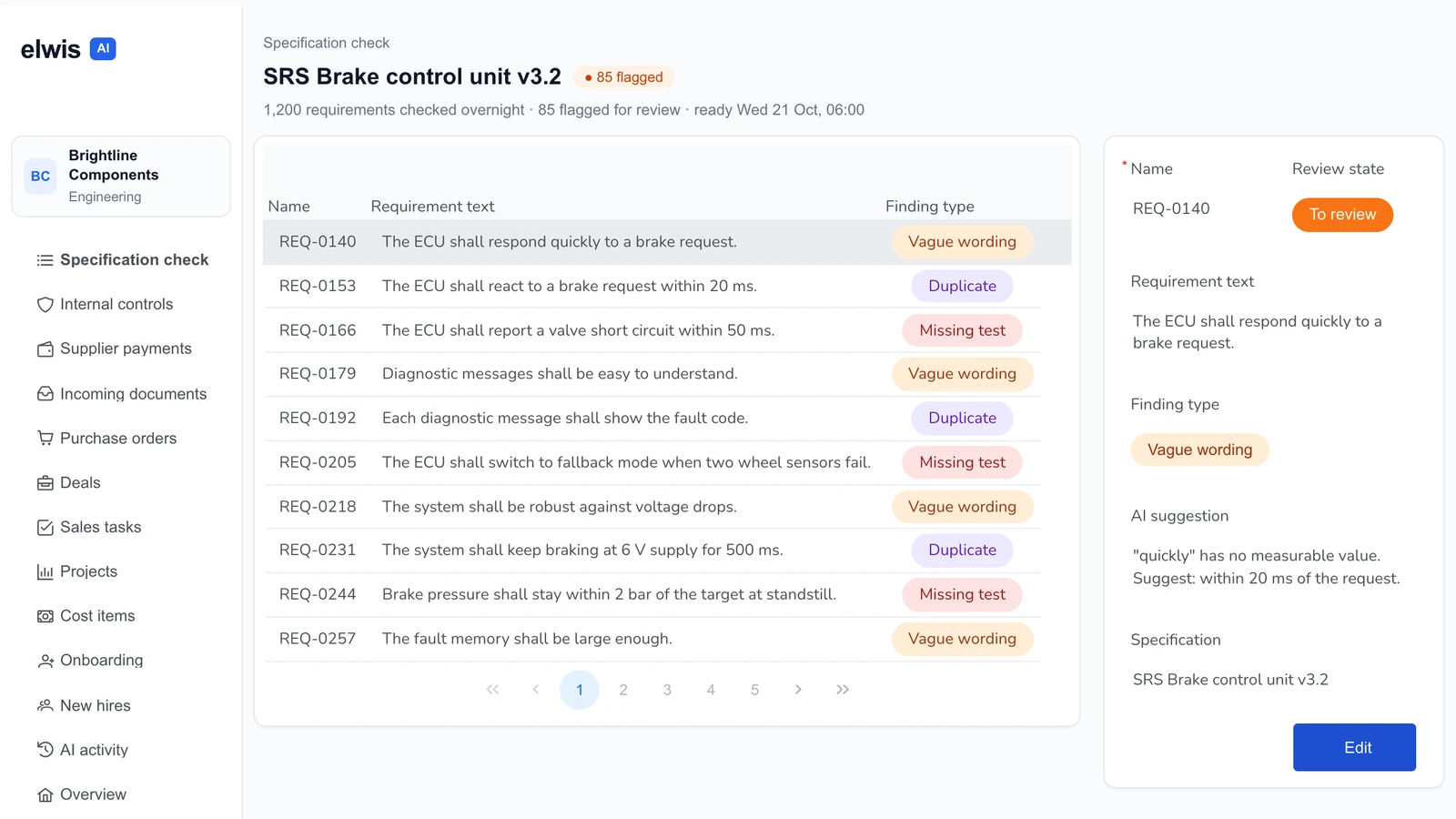
Reviews find vague wording, duplicates and missing tests late, after weeks of manual reading. With AI in ELWIS, a 1,200-requirement specification is checked overnight. Reviewers start with a list of 85 flagged items instead of reading every line.
FINANCE
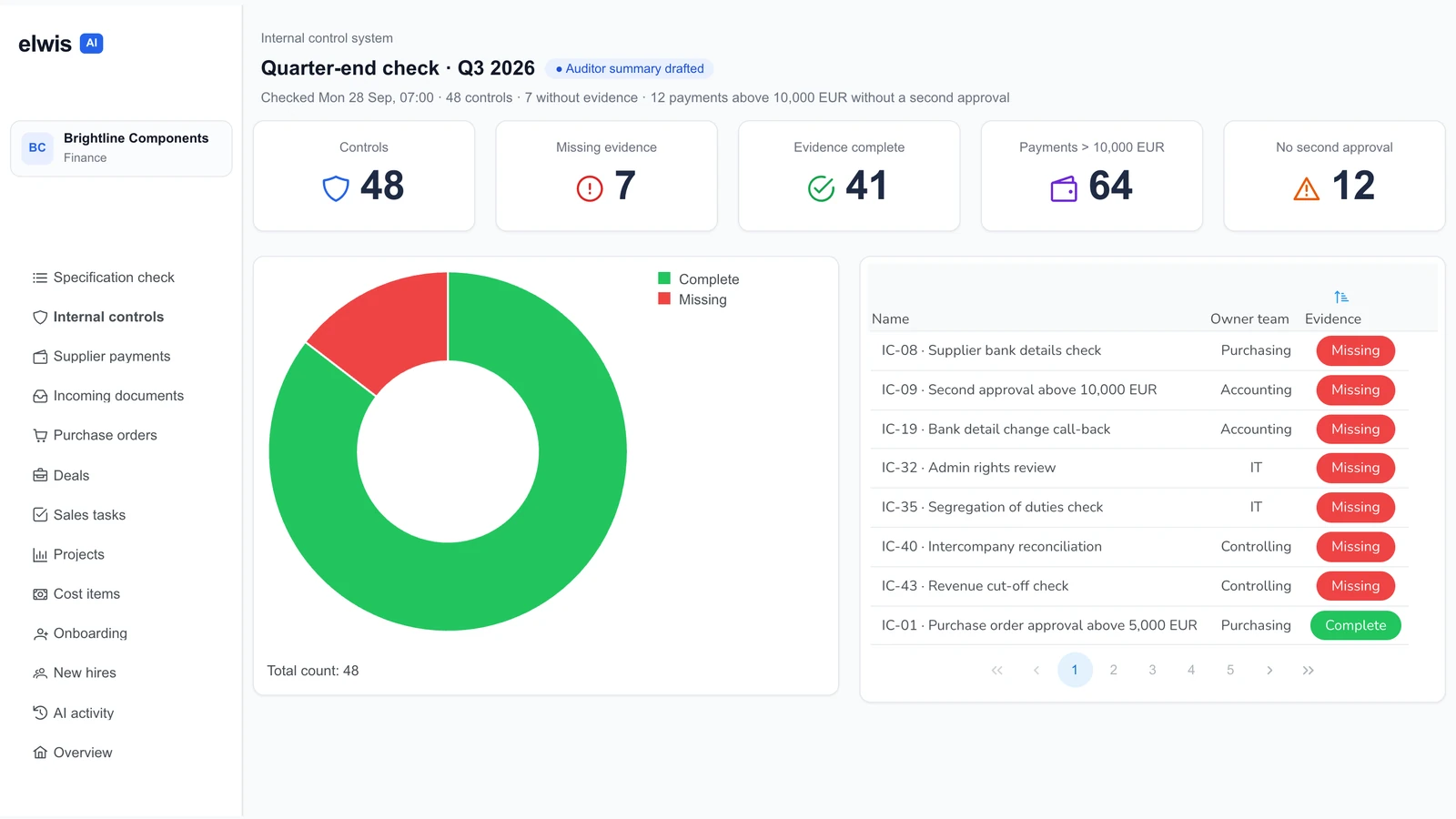
Controls live in spreadsheets. Evidence is collected by email, and audit preparation takes weeks every year. Before quarter-end, ELWIS lists every control still missing evidence. It also highlights 12 supplier payments above threshold without a second approval and drafts the summary for the auditor.
OPERATIONS
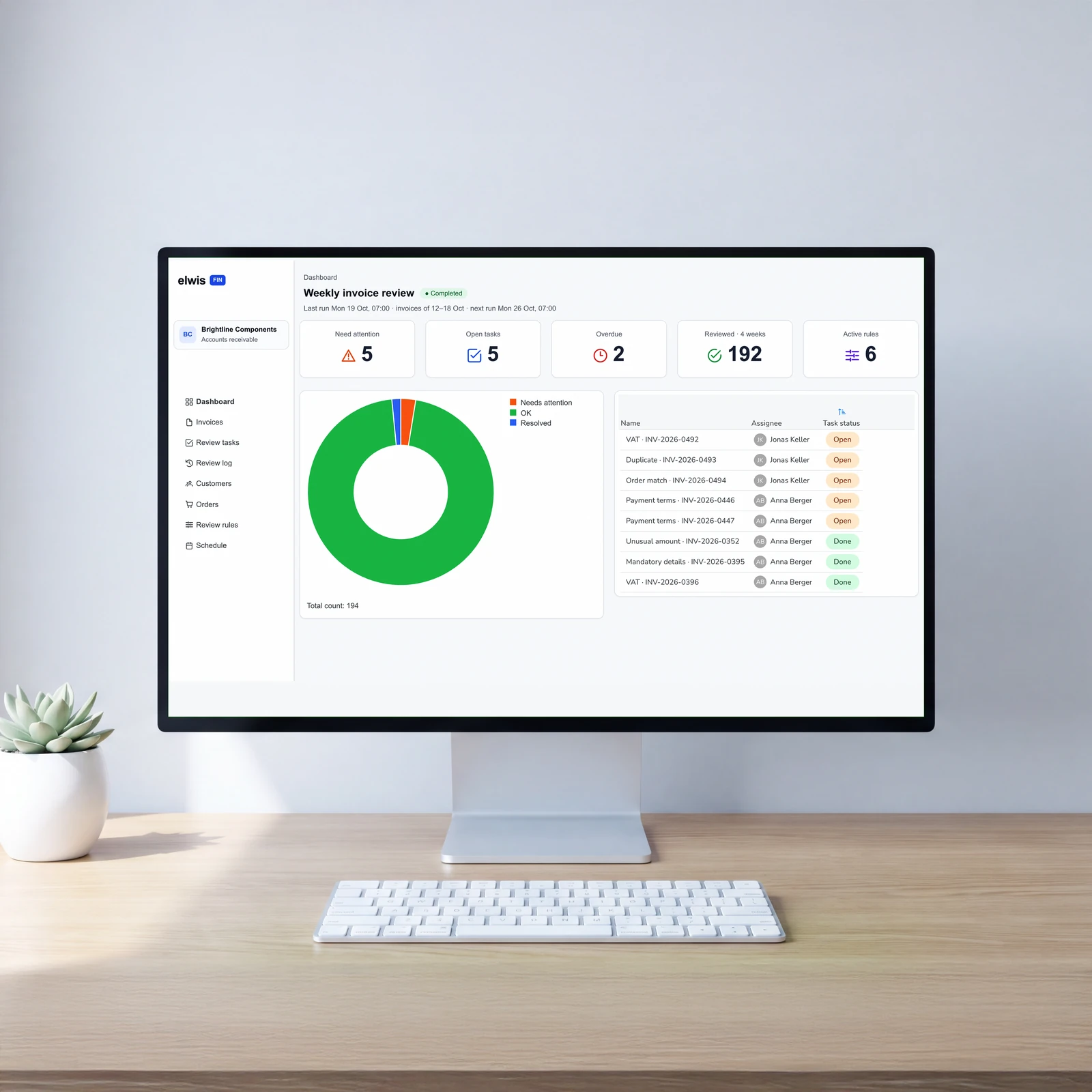
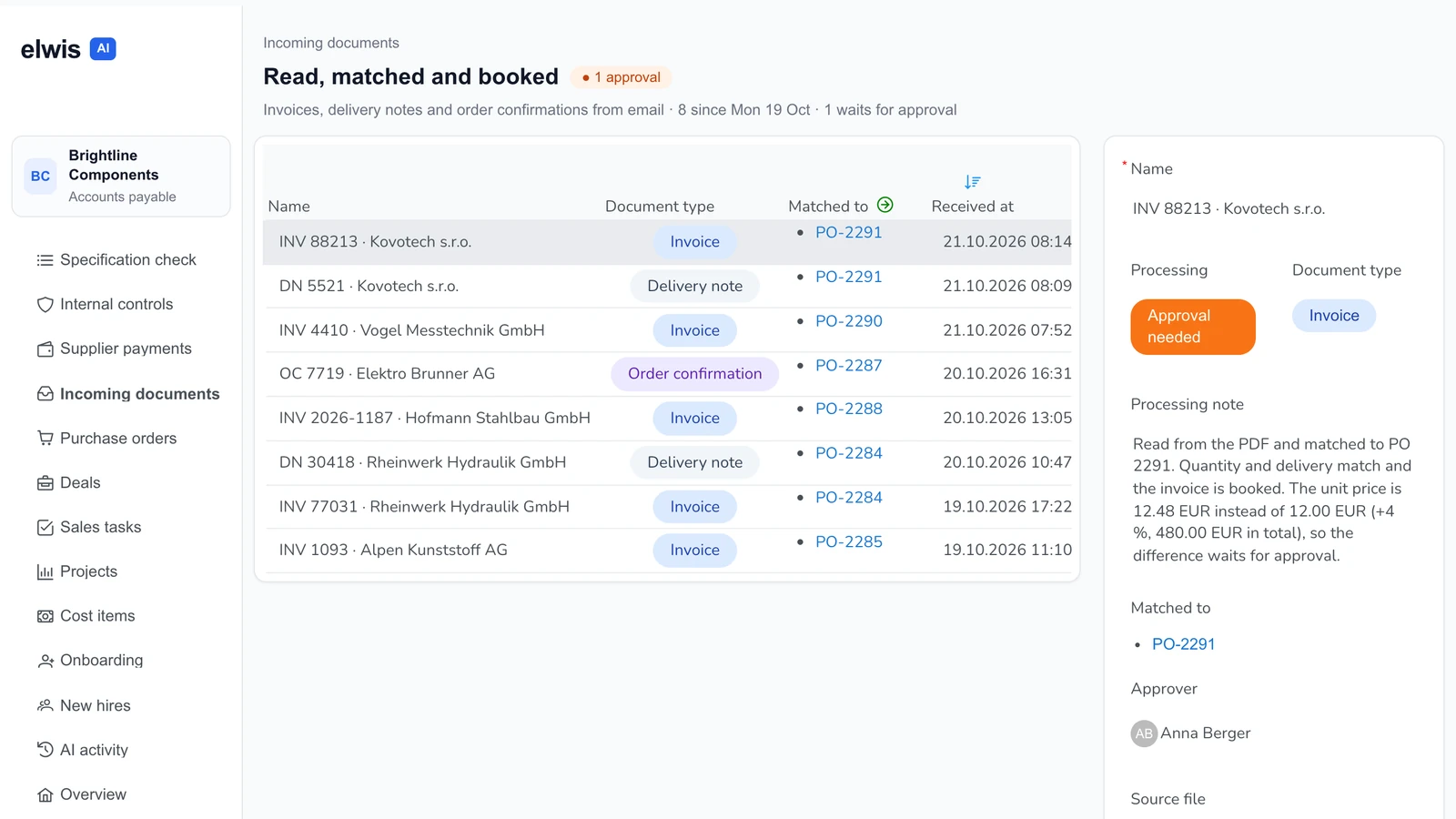
Invoices, delivery notes and order confirmations arrive as PDFs and are typed in by hand. With AI in ELWIS, an incoming invoice is read, matched to PO 2291 and booked automatically. Only the price difference of 4% goes to a person for approval.
SALES
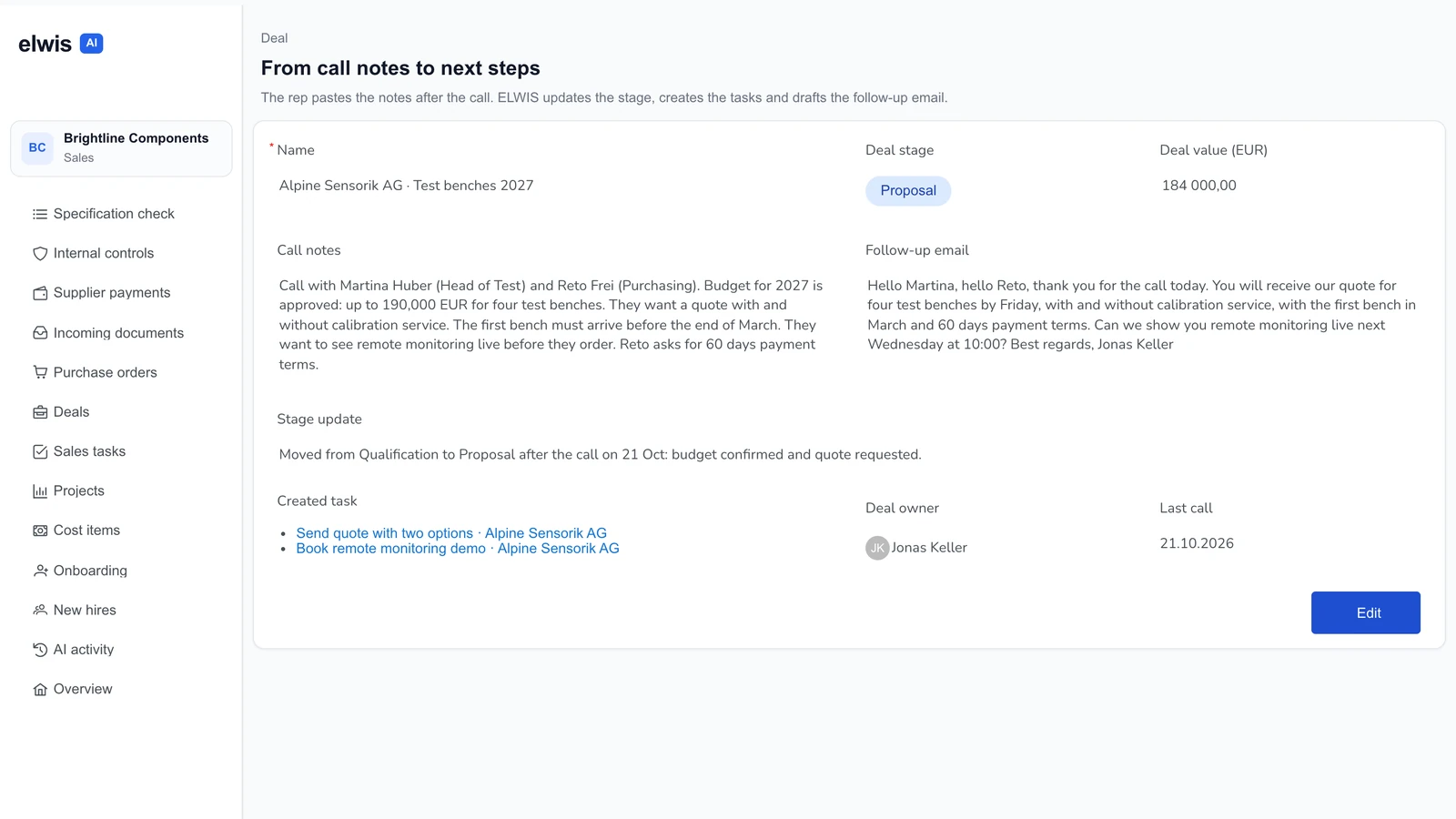
Notes, emails and next steps are spread out, and nobody has time to keep the CRM up to date. After a call, the rep pastes the notes. ELWIS updates the deal stage, creates two tasks and drafts the follow-up email.
MANAGEMENT
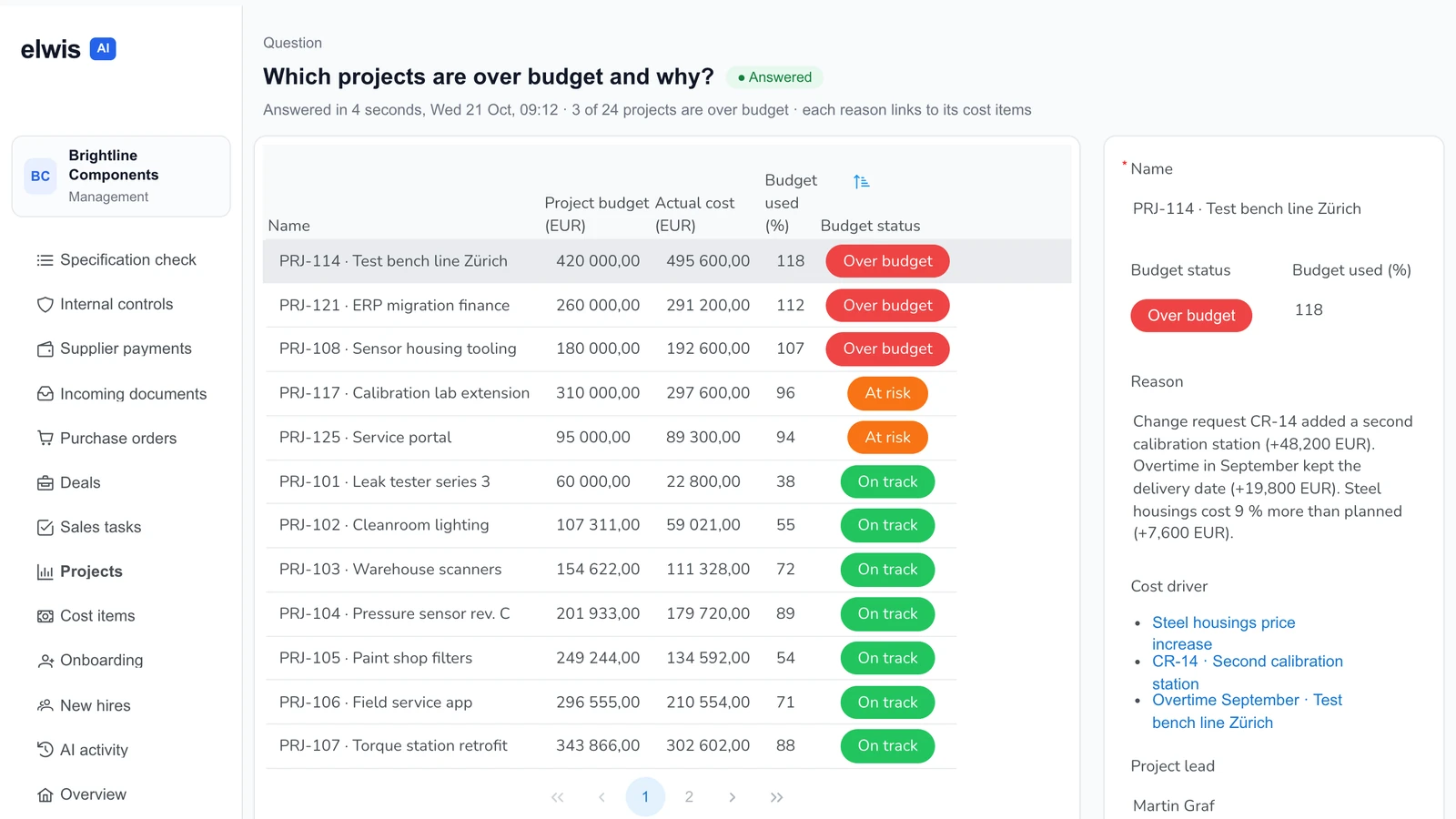
Simple questions need a data export, a spreadsheet and half a day of work. Ask “Which projects are over budget and why?” and the answer comes in seconds, with links to the underlying artifacts.
PEOPLE
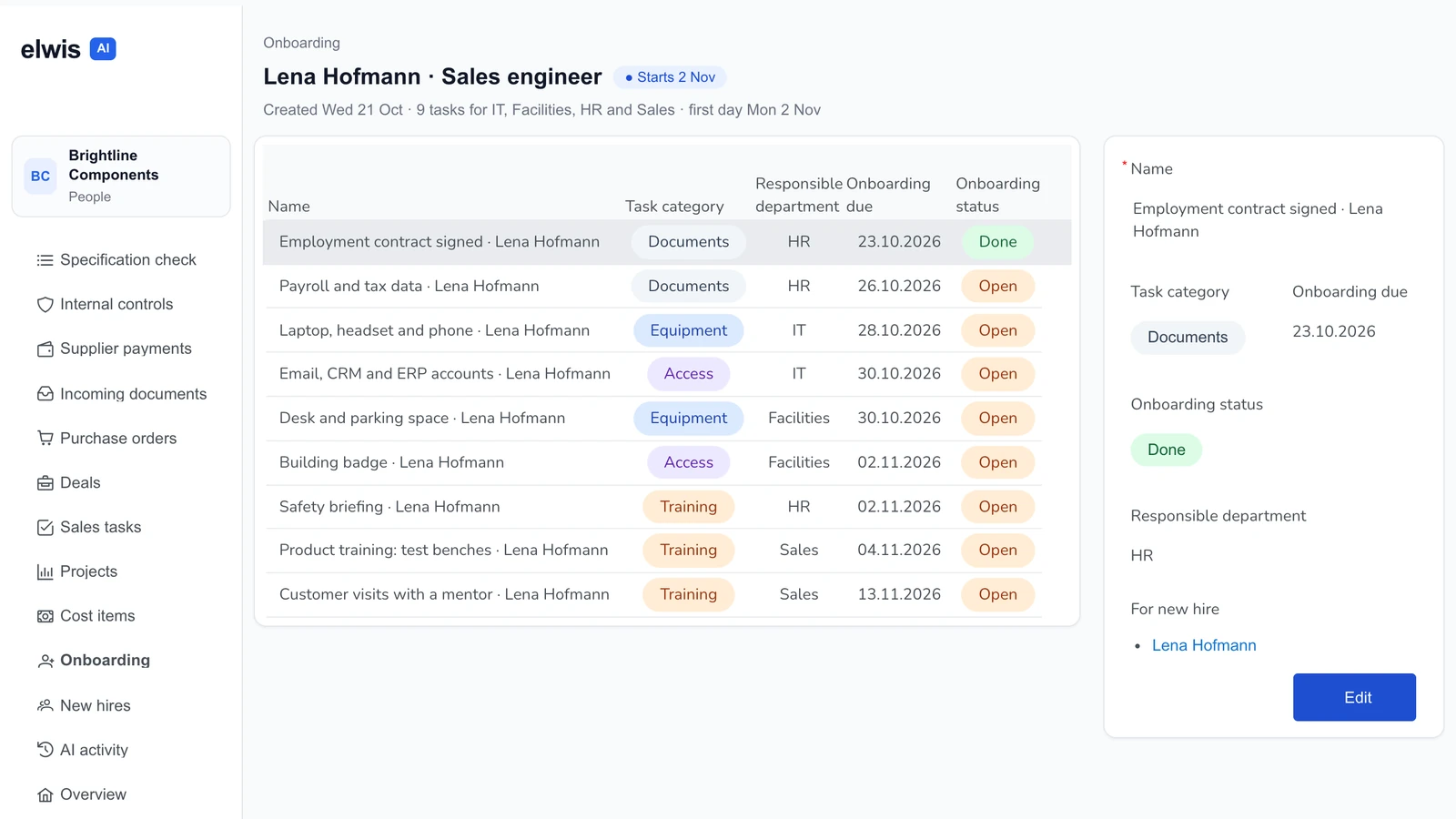
CVs, contracts and policies are read line by line, and onboarding checklists are kept by hand. When a new hire is created in ELWIS, equipment, access, training and documents are created as tasks for each department.
The solution
AI in ELWIS uses the same type system, the same roles and the same workflows as the rest of your application.
Page Builder
AI reads and writes artifacts, links and attributes, so its results land exactly where your process needs them.
Configurable Type System
AI suggests and people decide. Every suggestion can be accepted, edited or rejected inside the normal workflow.
Client-owned governance
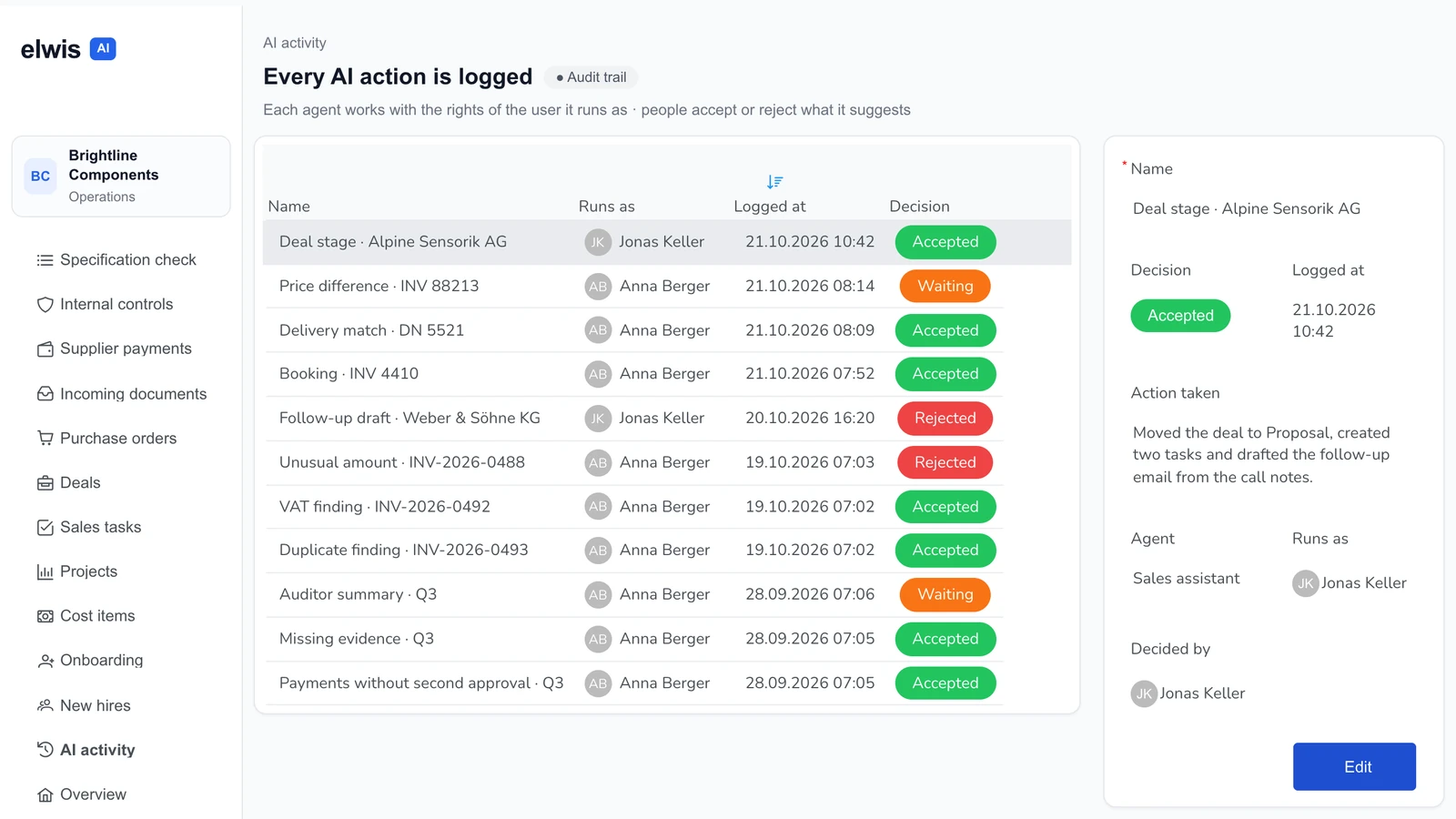
Role-based access applies to AI too. Every AI action is logged, so results stay auditable.
Before / After
Typical effort for recurring tasks, before and after AI support.
Area
Before
After ELWIS
Requirements review (500 reqs)
approx. 5 days of manual reading
AI pre-check overnight, then 2 to 3 days of focused review on flagged items
ICS quarter-end check
approx. 10 days of evidence chasing and documentation
Missing evidence and anomalies listed automatically, about 6 days in total
Invoice entry
approx. 8 minutes per invoice
approx. 2 minutes for checking and approval
CRM update after a call
approx. 15 minutes of notes, tasks and email
approx. 5 minutes to review the AI draft
Weekly management report
approx. 6 hours
approx. 1 hour, generated from live data and reviewed
How it works
You start with one process and real data. Once the results are measured, the same setup scales to more teams, with no new tool to introduce.
1
Pick the process
Choose one process with high manual effort, for example requirements reviews or ICS.
2
Model it in ELWIS
Map artifacts, attributes and roles, or use your existing ELWIS application.
3
Add AI steps
Define where AI extracts, checks, suggests or summarizes.
4
Pilot and measure
Run with real data, then measure time saved and quality gained.
5
Scale
Roll out to more teams and processes on the same platform.
Savings depend on the process, data quality and volume. The figures below are estimates based on typical manual effort and are validated together with you in a pilot.
up to 80%
less time for reports and summaries
up to 70%
less manual data entry from documents
~50%
less review effort in requirements management
~40%
faster ICS execution and audit preparation
Security & access control
Role-based access
AI only sees what the user is allowed to see.
Audit trail
Every AI suggestion and decision is logged.
Human approval
Critical steps always need a person to confirm.
Your data stays yours
Hosting and model options are agreed with you.
Conclusion
AI in ELWIS takes over rule-based work in any process you model, so your experts can focus on decisions.
PLANNED NEXT
01
Better quality before the review, not after
02
Controls evidenced continuously, not only at audit time
03
No more manual typing from documents
04
Answers in seconds instead of reports in hours
Book a 45-minute session tailored to your industry, team size, and deployment requirements. No generic pitches—just real answers from a solutions engineer.