Requirements usually live in Word documents, spreadsheets or heavyweight tools that only specialists can use. ELWIS Requirements Management brings modules, typed traceability and reviews into one platform, shaped around your engineering process and at a fraction of the usual cost.
The problem
Specifications are written in Word, traced in Excel and reviewed by email. Every change has to be followed up by hand, and audit evidence is assembled again before each gate.
01
Which version of the specification is the current one?
02
What is affected when this requirement changes?
03
Is every requirement covered by a test?
04
Who reviewed and approved what, and when?

Typed artifacts
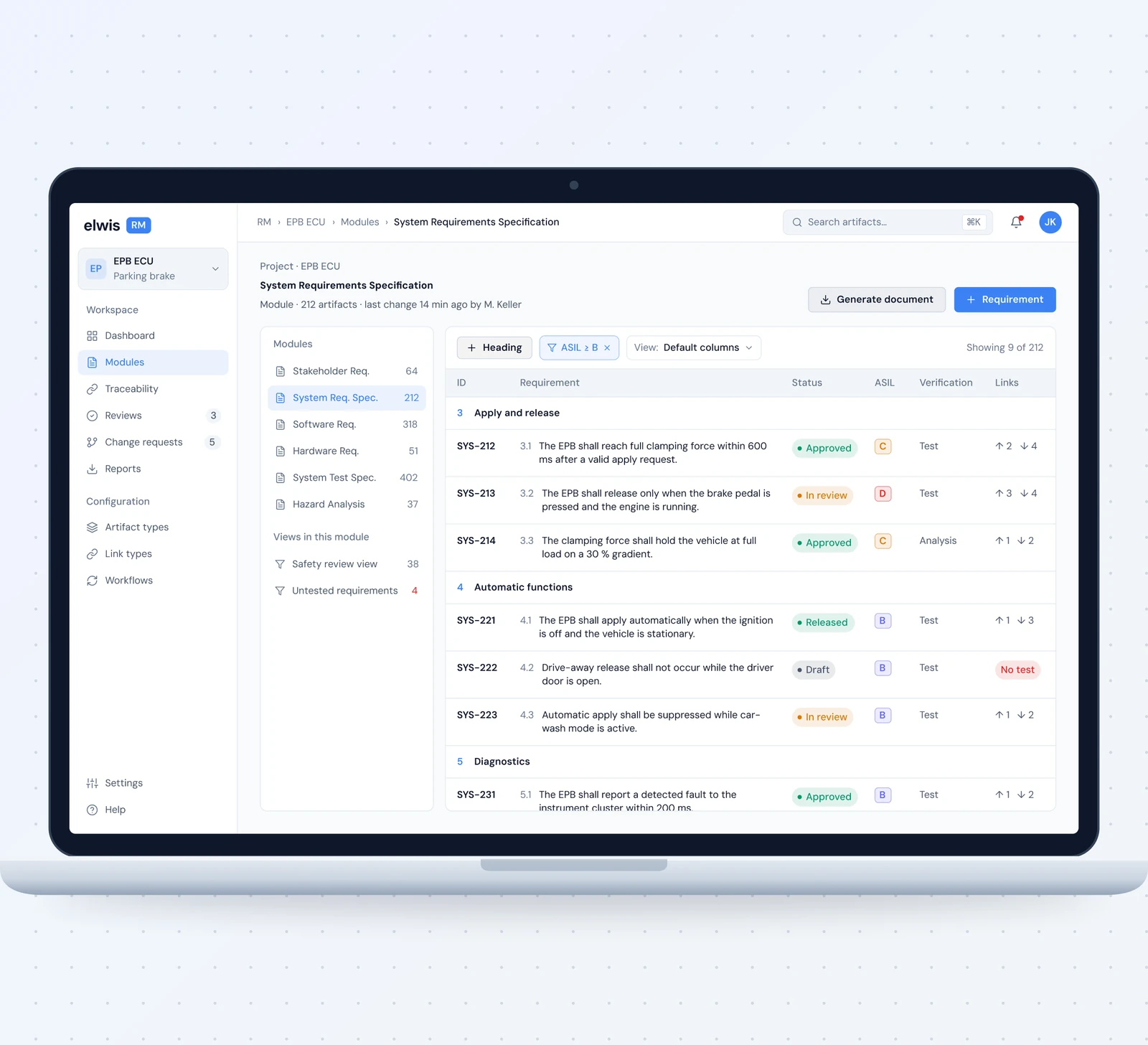
Stakeholder, system, software and test artifacts, each with its own attributes.

Document-style modules
Headings, numbering and requirements in one structured view.

End-to-end traceability
Typed links from need to test, with defined cardinality and mandatory links.

Reviews and approval
Live reviews on the current module. Formal reviews on frozen baselines from Q1 2027.

Controlled change
See what a change touches before it is approved.

Open interfaces
OSLC and REST to connect test, ALM and engineering tools.
Key features
Artifact types, modules, link types and traceability work the way requirements engineers expect.
AUTHORING
Write and structure requirements like a document, with every requirement as a typed, linkable artifact. Each artifact type carries your own attributes and enums, while modules keep headings, numbering and ordering in place. Views with columns and filters work directly inside modules, and every requirement supports rich text and attachments.
TRACEABILITY
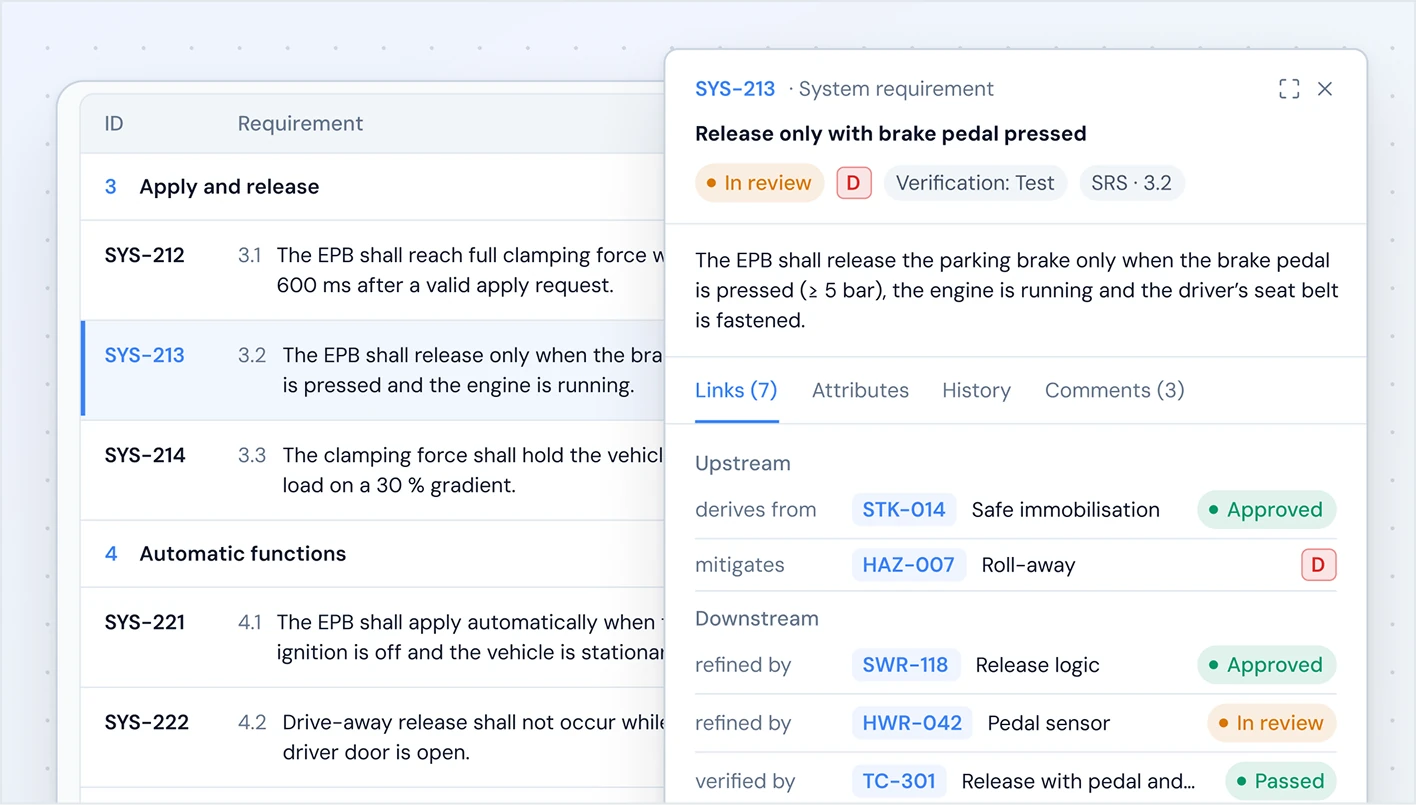
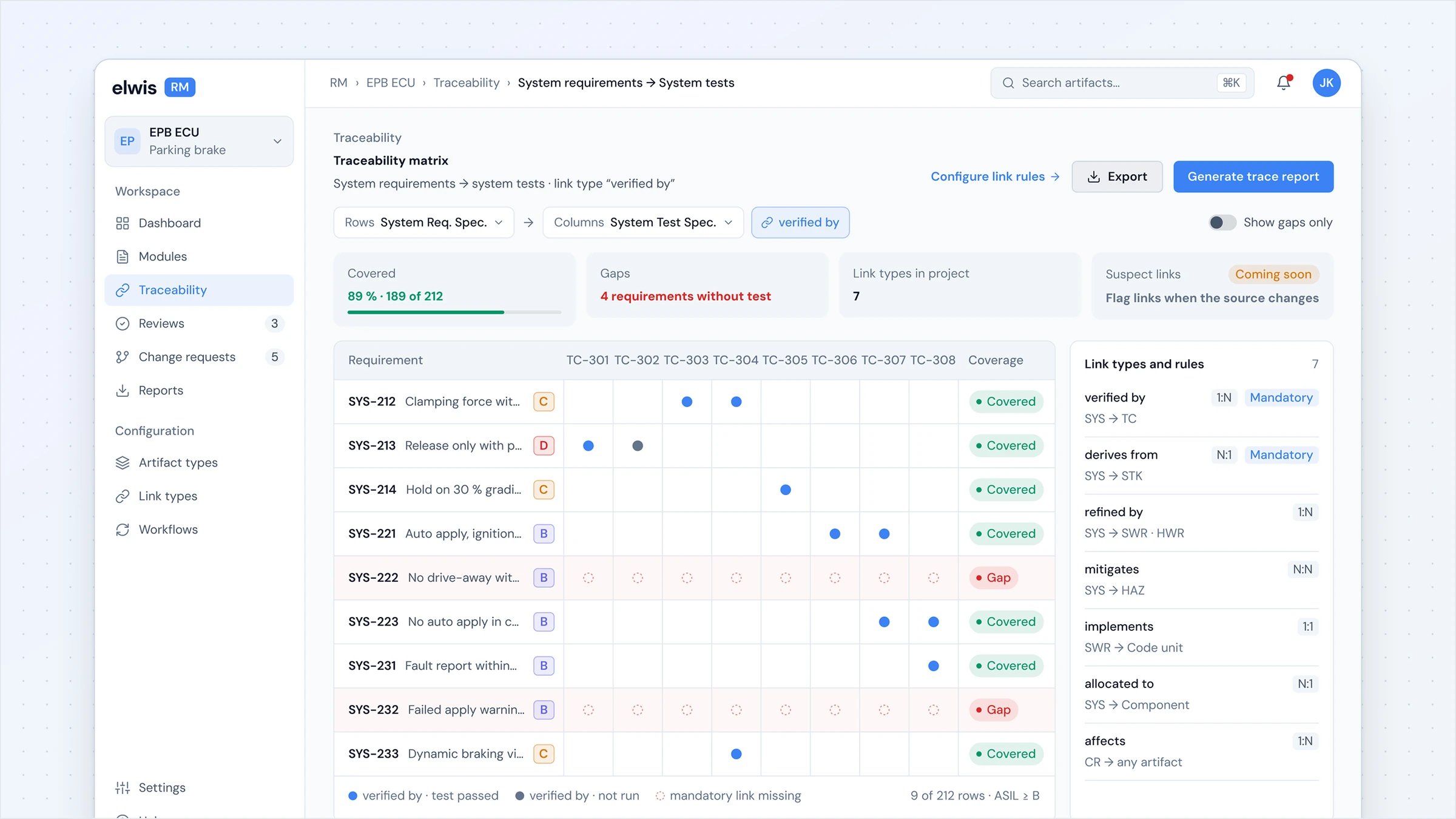
Every relationship is a typed link with rules (derives from, refined by, verified by) with cardinality 1:1, 1:N, N:1 or N:N. Mandatory links and allowed source and target types keep the structure consistent, and every artifact shows its incoming and outgoing links. Coverage and gaps are visible in the matrix, not rebuilt in spreadsheets. Suspect links on change are coming soon.
REVIEW
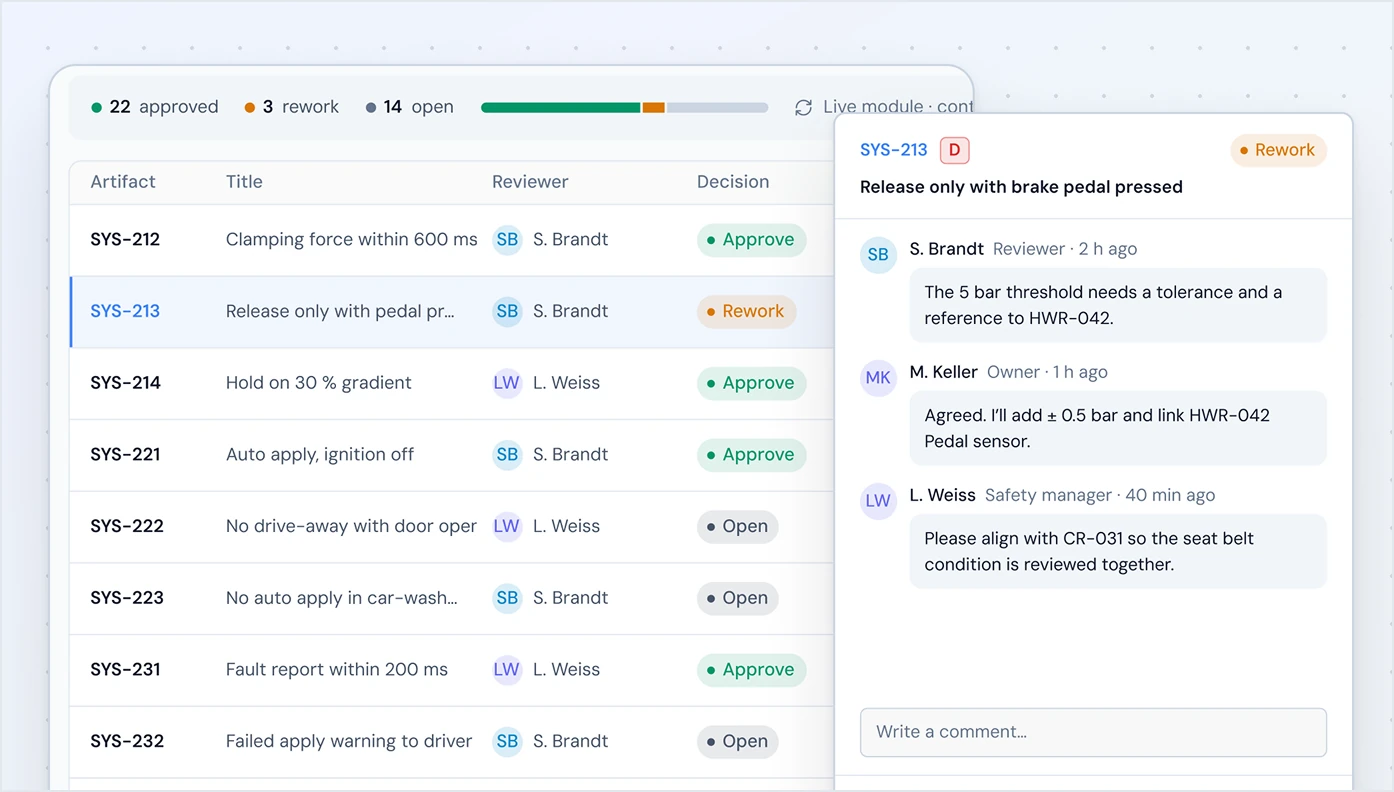
Review the living module while it is still being written, with comments on each requirement. Only defined roles can approve, and approved content is protected by field-level permissions. Formal reviews of frozen versions before a milestone come with baselines in Q1 2027.
CHANGE
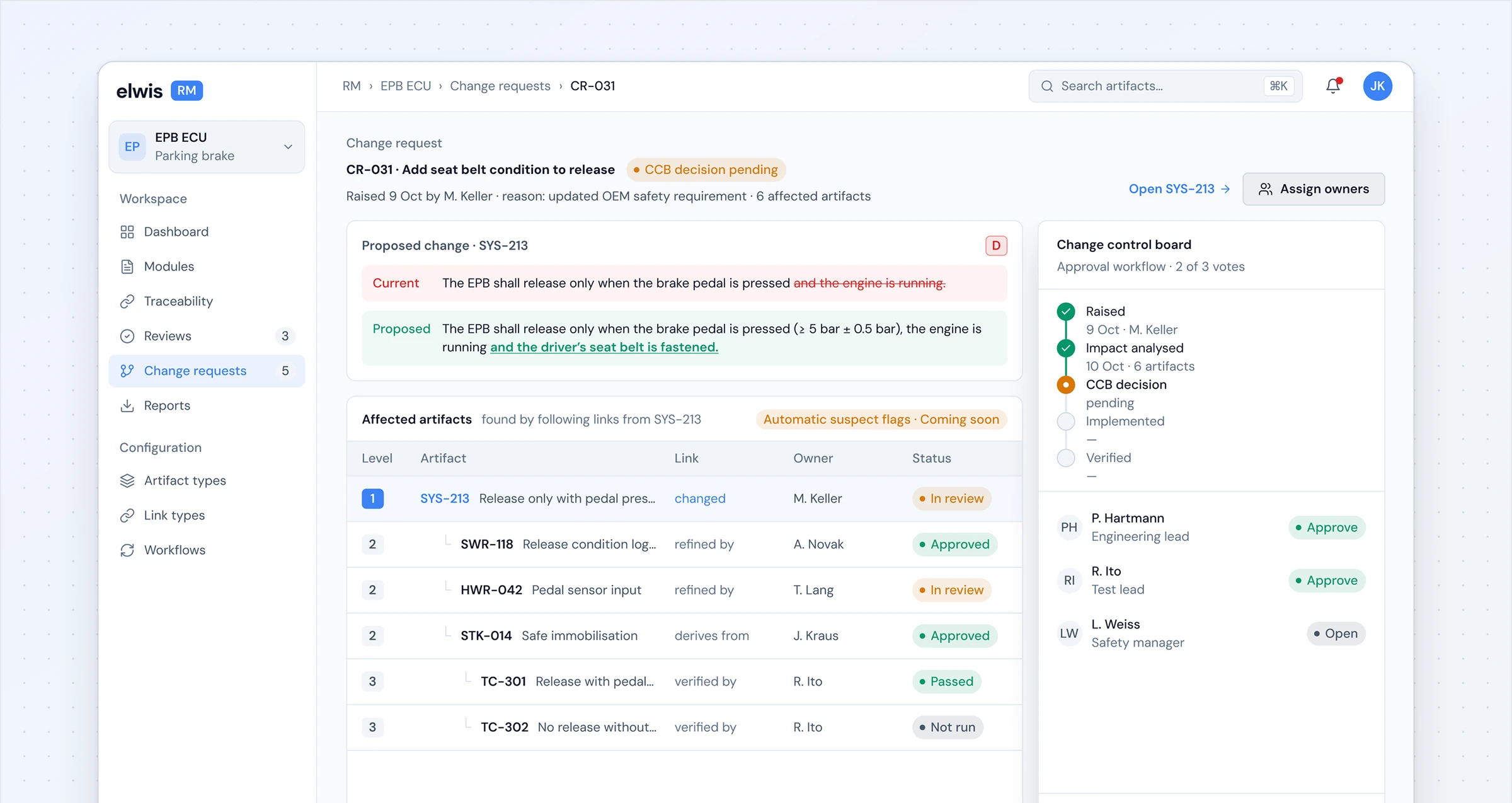
Change requests are their own artifact type and link to the requirements they affect. Following the links lists every affected requirement, design and test before the change board decides, and approval workflows guide the board through the decision. Automatic suspect flags on change are coming soon.
REPORTING
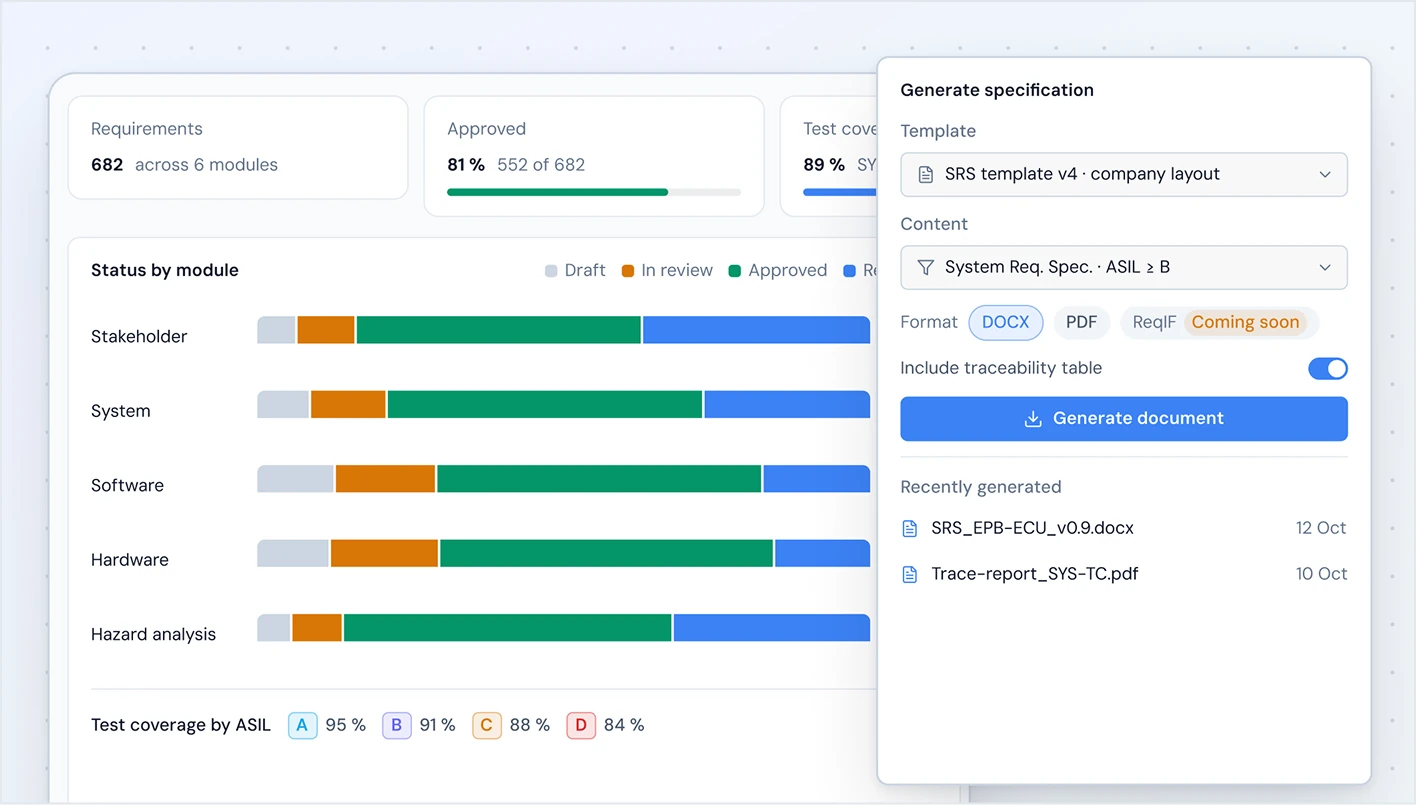
Project status runs on live data: dashboards show status, coverage and maturity, while specification documents and traceability reports are generated from the current content, in your template. OSLC links connect test and ALM tools, and ReqIF exchange with OEMs and suppliers is coming soon.
The solution
We map how your teams write, link, review and change requirements, then model exactly that in ELWIS. Standard building blocks cover the core, custom extensions cover what is specific to you.
Page Builder
Module views, matrices, dashboards and forms arranged by drag and drop, without front-end code.
Configurable Type System
Artifact types, attributes, link types and link rules defined for your V-model, reusable as a project template.
Client-owned governance
Your admins own roles, workflows and permissions. Changes do not need a developer.
Before / After
A lean option between Word or Excel and heavyweight enterprise RM suites, with traceability built in.
Area
Before
After ELWIS
Requirements
Word documents and spreadsheets, versions by file name
Typed artifacts in modules, one source of truth
Traceability
Excel trace tables, maintained by hand
Typed links with rules, coverage matrix on live data
Reviews
Comments by email, decisions hard to find
Reviews in the system, decision per requirement and reviewer
Change
Impact estimated from memory
Affected artifacts listed via links before approval
Specifications
Copied together before every gate
Generated from current data in your template
How it works
Built from standard ELWIS building blocks: type system, page builder, workflow engine, document generation, role-based permissions and open interfaces.
1
Define the model
Artifact types, attributes and link types for your V-model.
2
Write or import
Create requirements in modules or import existing specifications.
3
Link across levels
Trace needs to system, software, hardware and tests.
4
Review and approve
Reviewers comment and decide, the status moves on automatically.
5
Manage change
Change requests show the impact before the board decides.
6
Report and deliver
Dashboards for the team, generated specifications for customers and audits.
ELWIS RM is not a separate product built from scratch. It is a solution layer on a platform already running CRM, ERP and order management systems in production, as SaaS, on-premise or private cloud.
1:1 · 1:N · N:N
link cardinalities, plus mandatory links
OSLC + REST
open interfaces to ALM and test tools
SaaS or on-prem
Docker-based, inside your perimeter
0 code
to adapt types, views and workflows
Security & access control
Role-based access control
Each role sees and edits only what it needs.
Field-level permissions
Approved content stays protected.
Two-factor authentication
A second factor at every sign-in.
Secure API access
Authenticated, permission-checked OSLC and REST access.
Conclusion
The core of professional requirements management, on a platform you can adapt yourself and extend to change boards, supplier portals or any other process.
PLANNED NEXT
AI assistant that runs workflows: next release
Baselines and formal reviews: Q1 2027
Suspect links: coming soon
ReqIF import and export: coming soon
01
One source of truth
Every requirement, link and decision in one system.
02
Traceability by design
Coverage and gaps visible every day.
03
Faster reviews
No email ping-pong, every decision recorded.
04
Lower cost
Predictable platform pricing instead of seat counting.
05
Room to grow
More processes on the same platform and data.
Book a 45-minute session tailored to your industry, team size, and deployment requirements. No generic pitches—just real answers from a solutions engineer.